Visual references for my Nsibidi research

My own visual references and the ones I collected while drawing the glyphs, in one place. Each is credited to its original source where I could find it.

My visual references

The images I kept while drawing the glyphs. 12 images

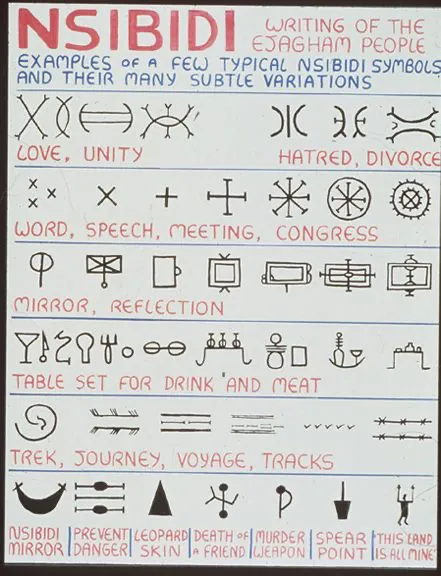
  • A hand-lettered chart in red and blue titled “Nsibidi: writing of the Ejagham people”, showing typical signs and their variations for love, hatred, speech, mirror, a table set for drink and meat, journeys, and single signs such as leopard skin and spear point.
    Nsibidi: writing of the Ejagham people Source not found The same chart appears in the book page under Collected references, credited there to books by P. Amaury Talbot.
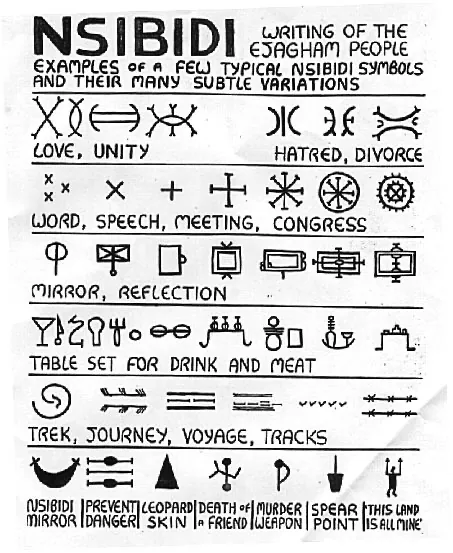
  • A black-and-white photocopy of the hand-lettered chart “Nsibidi: writing of the Ejagham people”, with rows of signs for love, hatred, speech, mirror, a table set, journeys and single signs.
    The same chart, photocopied Source not found
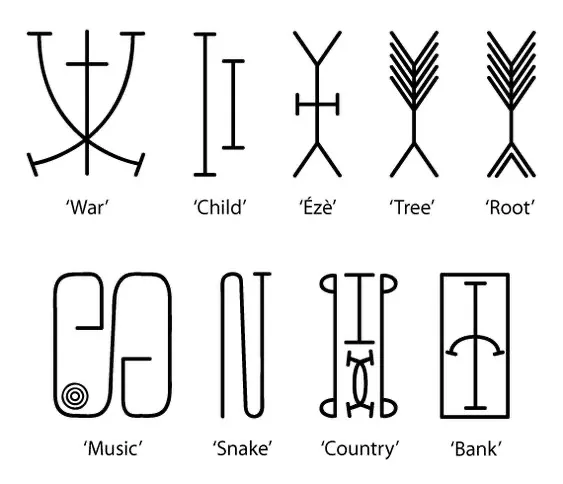
  • Nine Nsibidi signs drawn in an even black line, labelled War, Child, Ézè, Tree, Root, Music, Snake, Country and Bank.
    Signs for war, child, ézè, tree, root, music, snake, country and bank Source not found
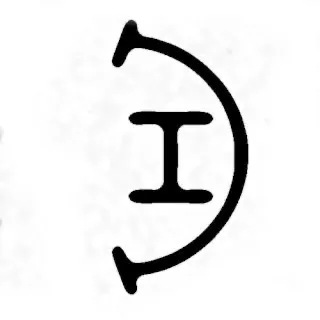
  • A single Nsibidi sign in black on white: a half-circle with flared ends curving around an I-shaped bar.
    A single sign: an arc around a bar Source not found
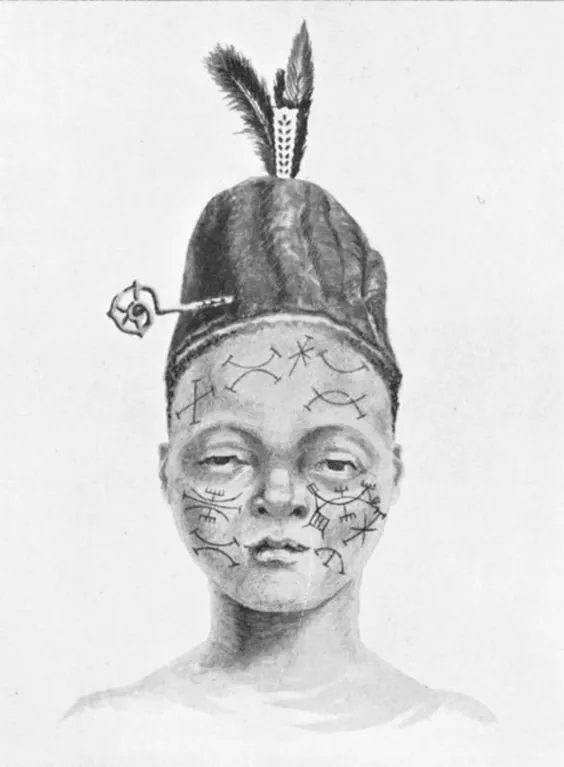
  • A monochrome painted portrait of a young person in a tall cap with two feathers and a pin, with Nsibidi signs drawn on the forehead and both cheeks.
    Portrait with Nsibidi signs on the face Source not found
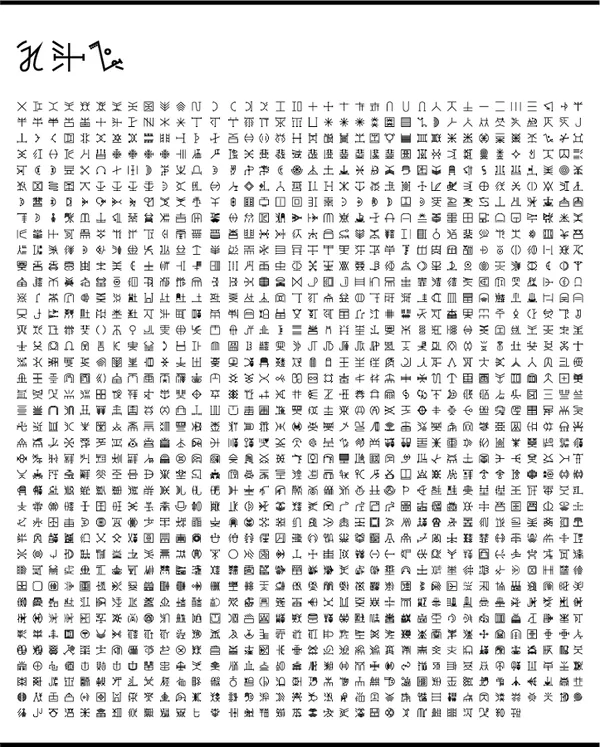
  • A dense grid of several hundred modern Nsibiri characters in black on white, under a short title in the same script.
    A full set of Nsibiri characters Source not found Modern Nsibiri characters, the script of the Ode Nsibiri project.
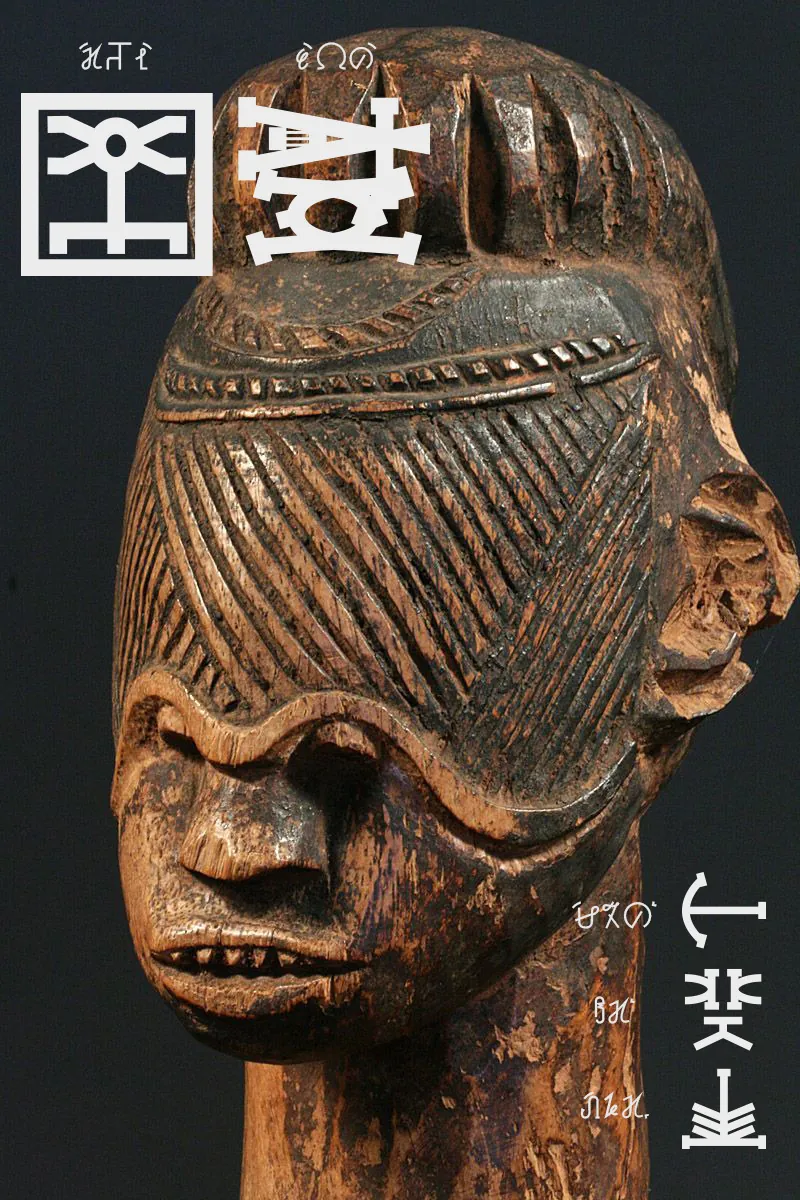
  • A carved wooden head with deep diagonal scarification lines, photographed on dark grey, overlaid with two large white Nsibiri characters and smaller white labels.
    Nsibiri labels on a carved head Source not found
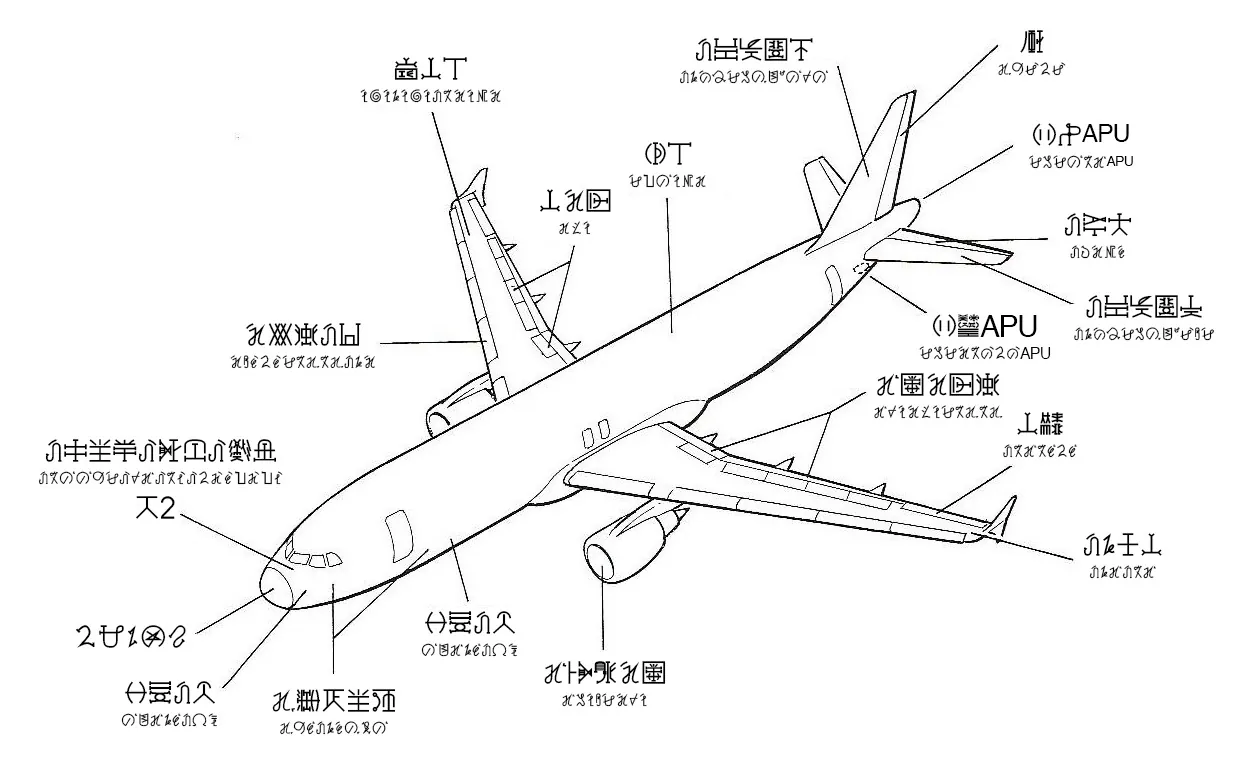
  • A line drawing of a twin-engine airliner with its parts (wings, tail, engines, nose, APU) labelled in Nsibiri characters with smaller Akagu spellings.
    An airliner labelled in Nsibiri Source not found
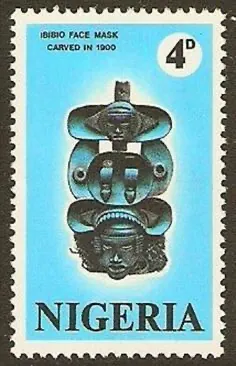
  • A Nigerian 4d postage stamp in pale blue showing a dark carved mask, labelled “Ibibio face mask carved in 1900”.
    Nigerian stamp: Ibibio face mask Source not found
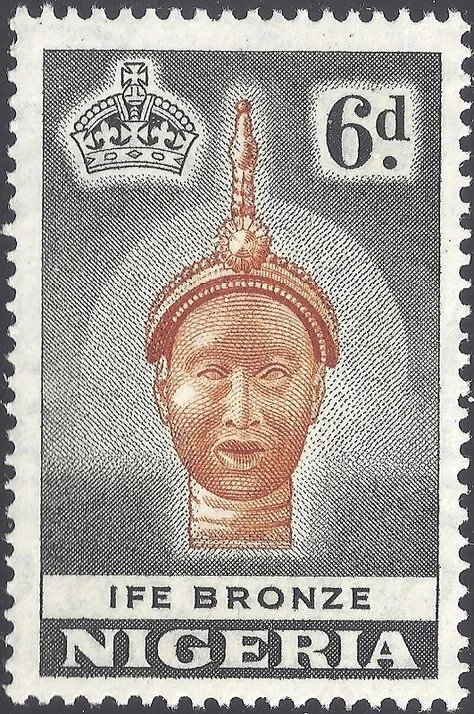
  • A Nigerian 6d postage stamp showing an Ife bronze head in orange-brown on grey and black, with a crown at the top left.
    Nigerian stamp: Ife bronze Source not found
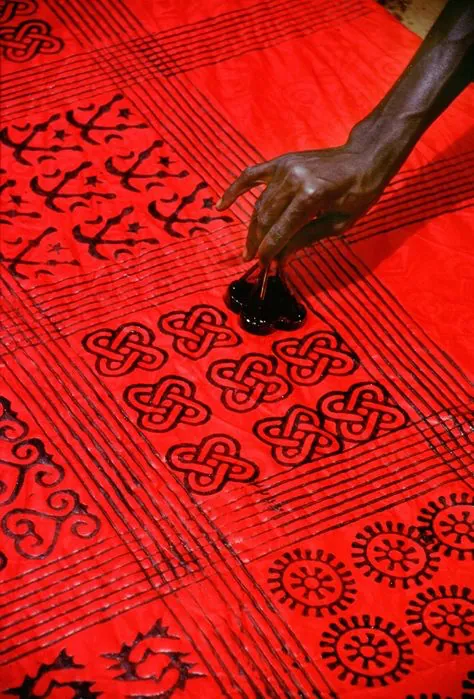
  • A hand lifting a carved stamp from red cloth printed in black with rows of interlaced knot motifs, wheel motifs and other Adinkra symbols.
    Stamping Adinkra symbols on red cloth Source not found Adinkra is from Ghana, not Nsibidi; kept as a reference for printed sign systems.
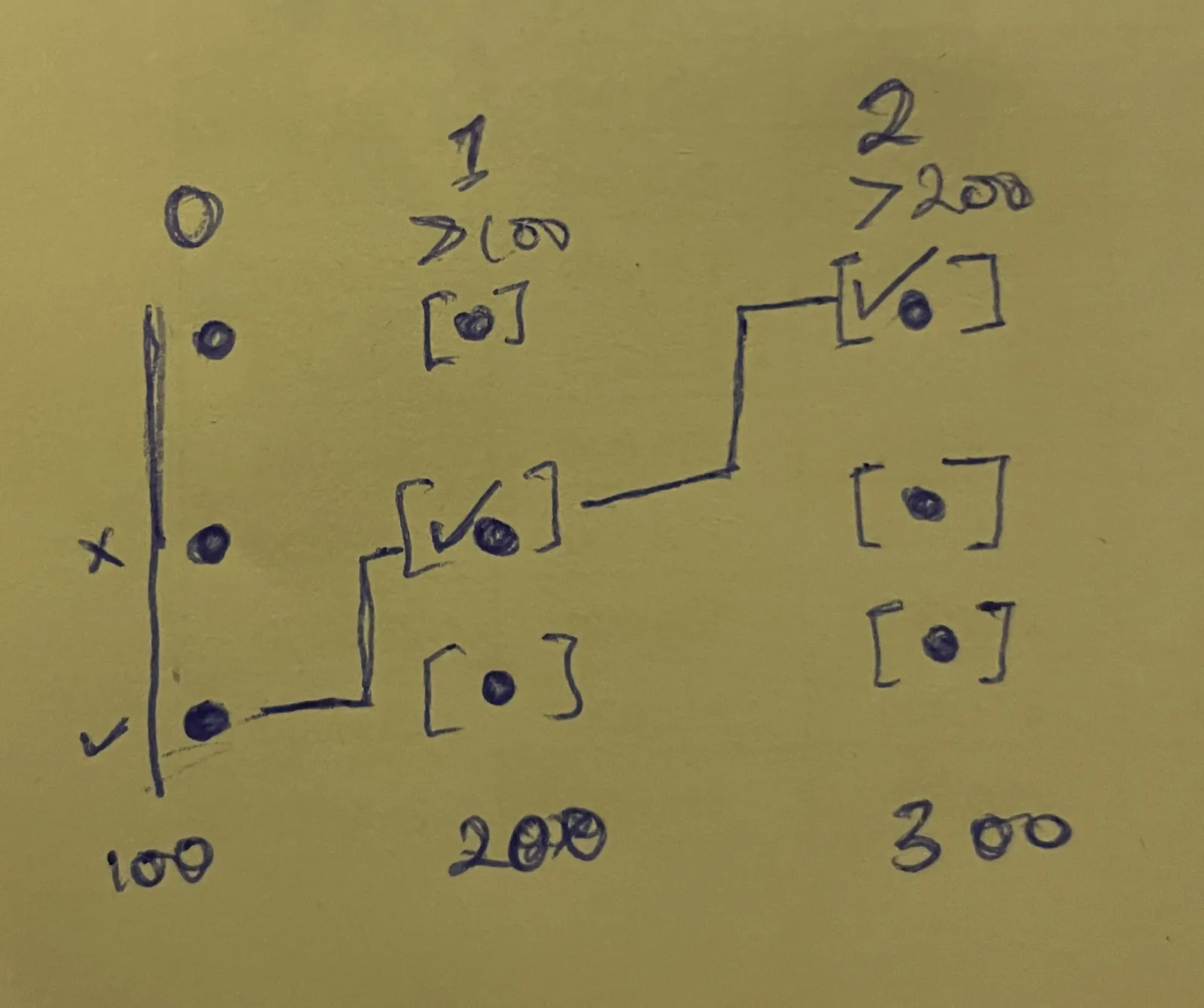
  • A sketch in blue ink on yellow paper: three columns headed 0, 1 and 2 over 100, 200 and 300, with dots in square brackets and a stepped line joining the ticked ones.
    My sketch My photo

Collected references

Charts, objects and screenshots I gathered along the way. 16 images

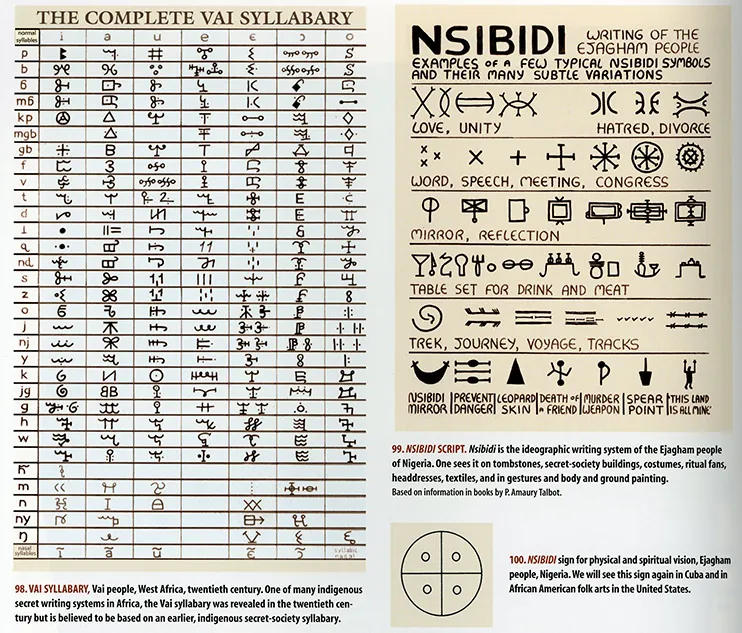
  • A book spread with the complete Vai syllabary table on the left; on the right the chart “Nsibidi: writing of the Ejagham people” and a circle divided into four, captioned as the Nsibidi sign for physical and spiritual vision.
    Book page: the Vai syllabary and Nsibidi Source not found The page credits the Nsibidi chart to “information in books by P. Amaury Talbot”.
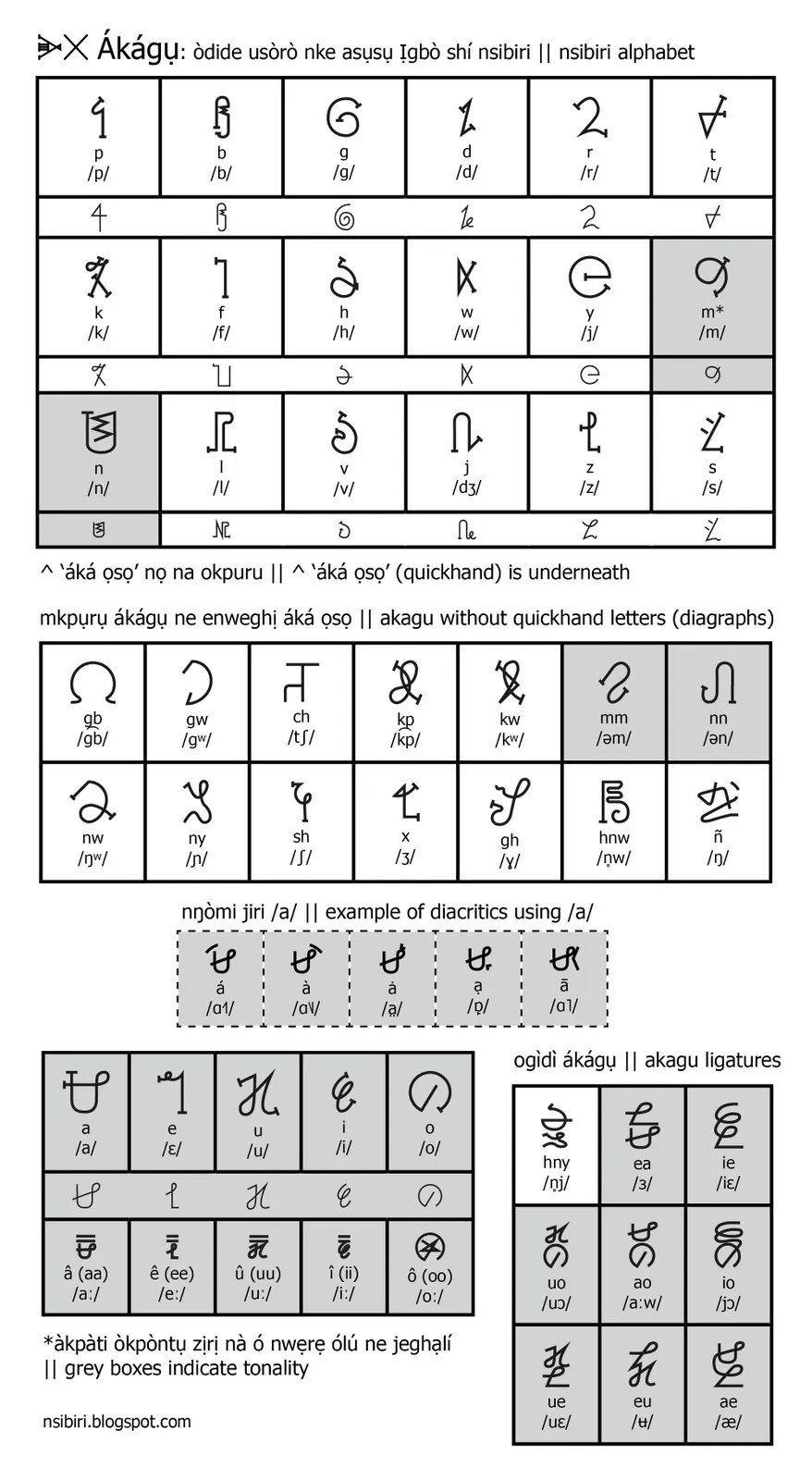
  • A chart of the Ákágụ alphabet for writing Igbo: each letter with its sound and its quickhand form underneath, then digraphs, diacritics on /a/, vowels and ligatures, signed nsibiri.blogspot.com.
    The Ákágụ alphabet for Igbo Ode Nsibiri The chart is signed nsibiri.blogspot.com, now blog.nsibiri.org.
  • A smaller, lower-resolution version of the Ákágụ alphabet chart, with different letters shaded grey to show tone, signed nsibiri.blogspot.com.
    An earlier version of the same chart Ode Nsibiri
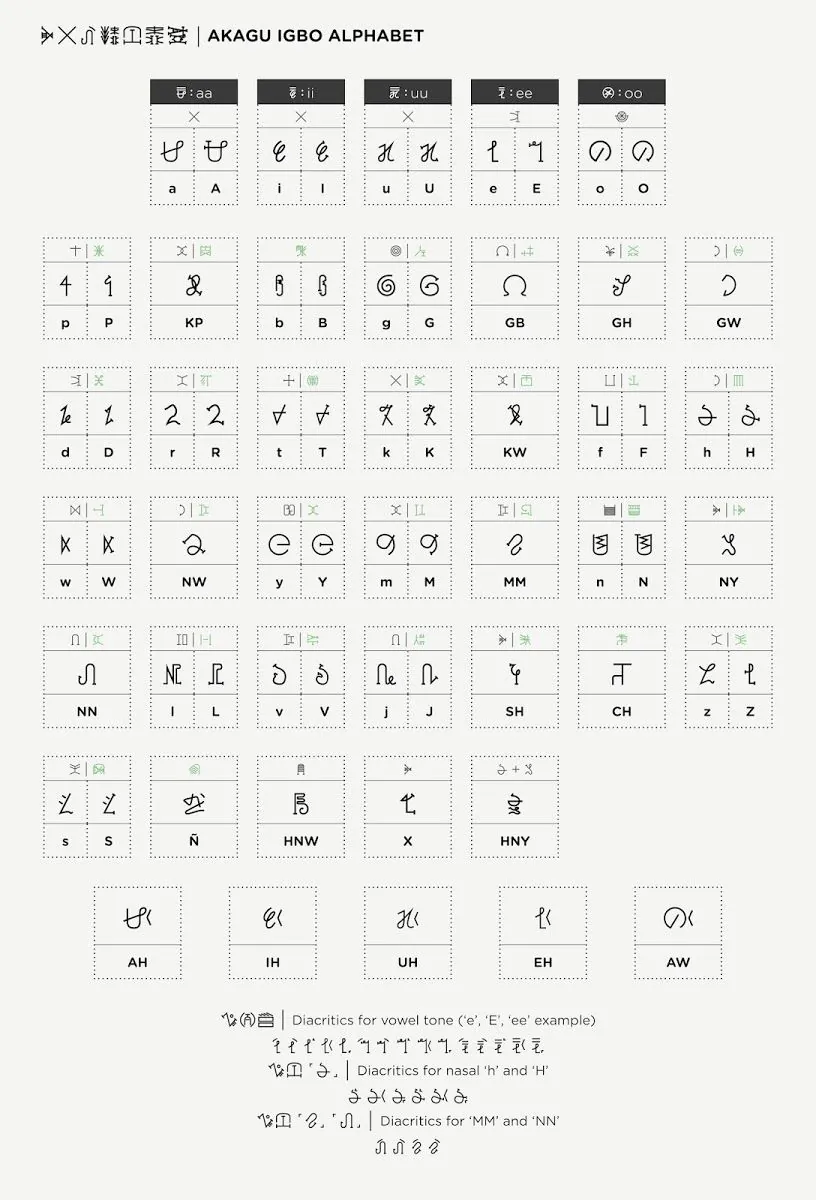
  • A typeset chart titled “Akagu Igbo alphabet”: each Akagu letter in a dotted box with its Latin letter, its radicals in green above, then digraphs and the diacritics for vowel tone and nasals.
    Akagu Igbo alphabet Ode Nsibiri Akagu is the alphabet of the Ode Nsibiri project; the post this chart came from was not found.
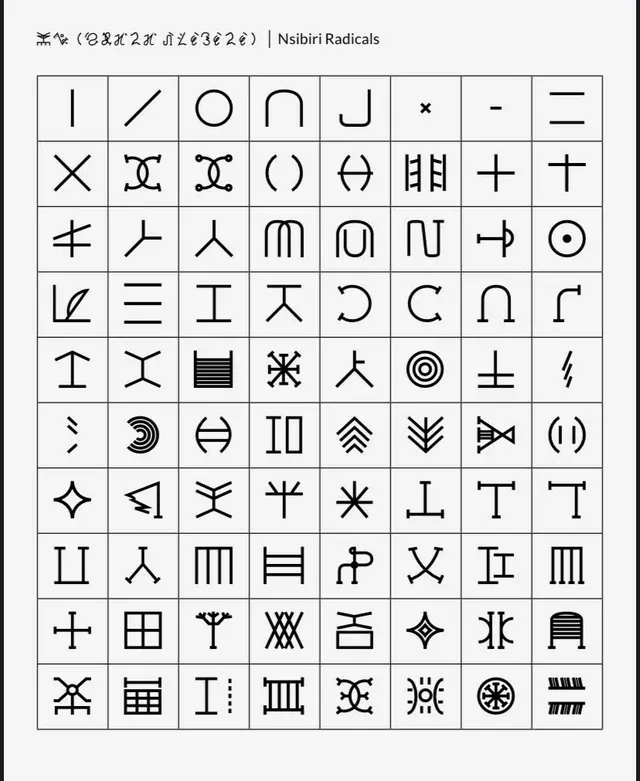
  • A ten-by-eight grid titled “Nsibiri Radicals”: simple strokes, arcs, crosses, circles, combs and stars that Nsibiri characters are built from.
    Nsibiri radicals Ode Nsibiri Nsibiri is the Ode Nsibiri project’s script; the post this chart came from was not found.
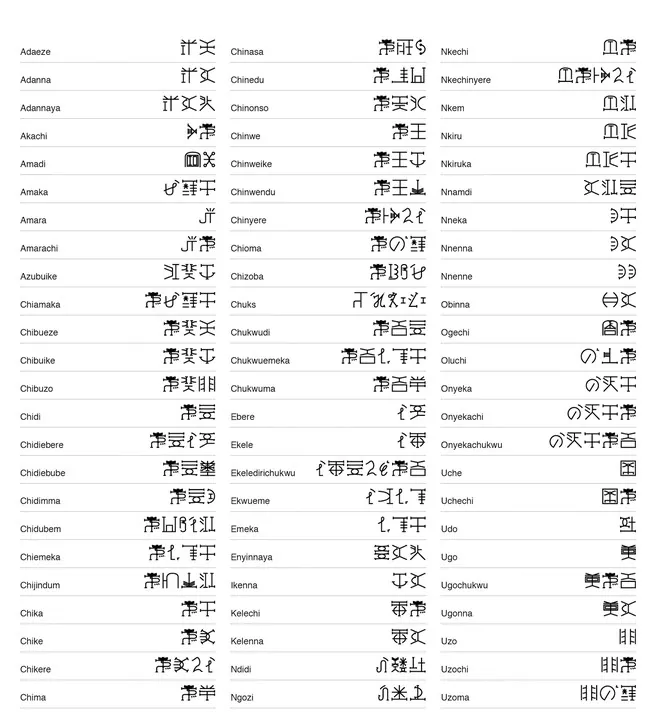
  • Three columns of Igbo given names from Adaeze to Uzoma, each with its spelling in Nsibiri characters.
    Igbo given names in Nsibiri Igbo names in Nsibiri, Ode Nsibiri
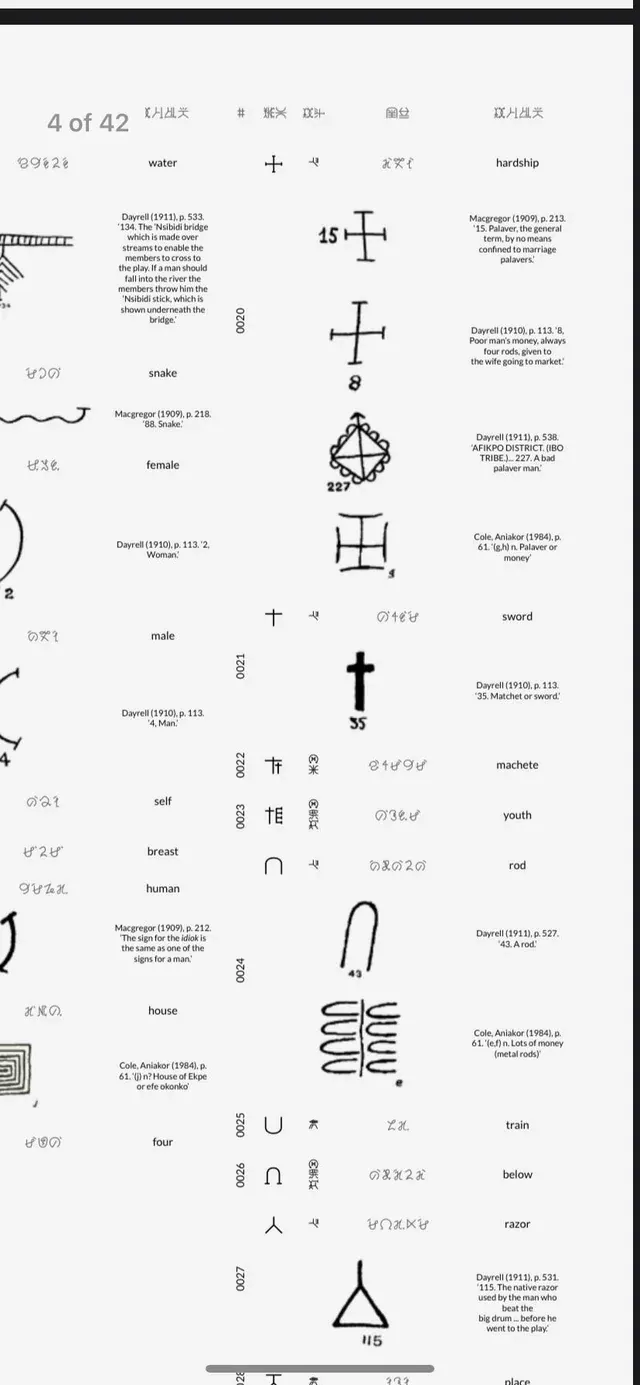
  • A phone screenshot of page 4 of 42 of a Nsibidi glossary: signs for water, snake, female, male, house, sword, machete and more, each with its Akagu spelling and a note citing Dayrell, Macgregor or Cole.
    A Nsibidi glossary, page 4 of 42 Source not found
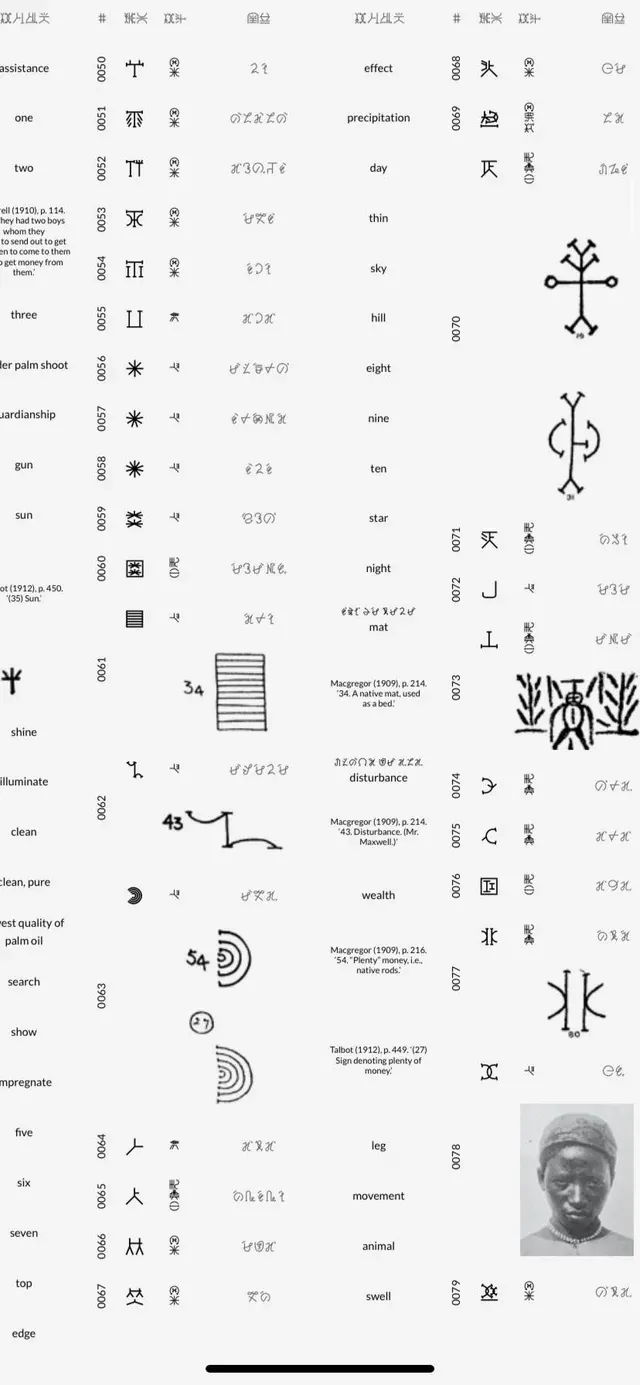
  • A phone screenshot of another page of the glossary: numbered entries for one to ten, sun, star, day, night, mat and more, with sign drawings cited to Macgregor, Dayrell and Talbot and an old portrait photograph.
    The same glossary: numbers, sun and stars Source not found
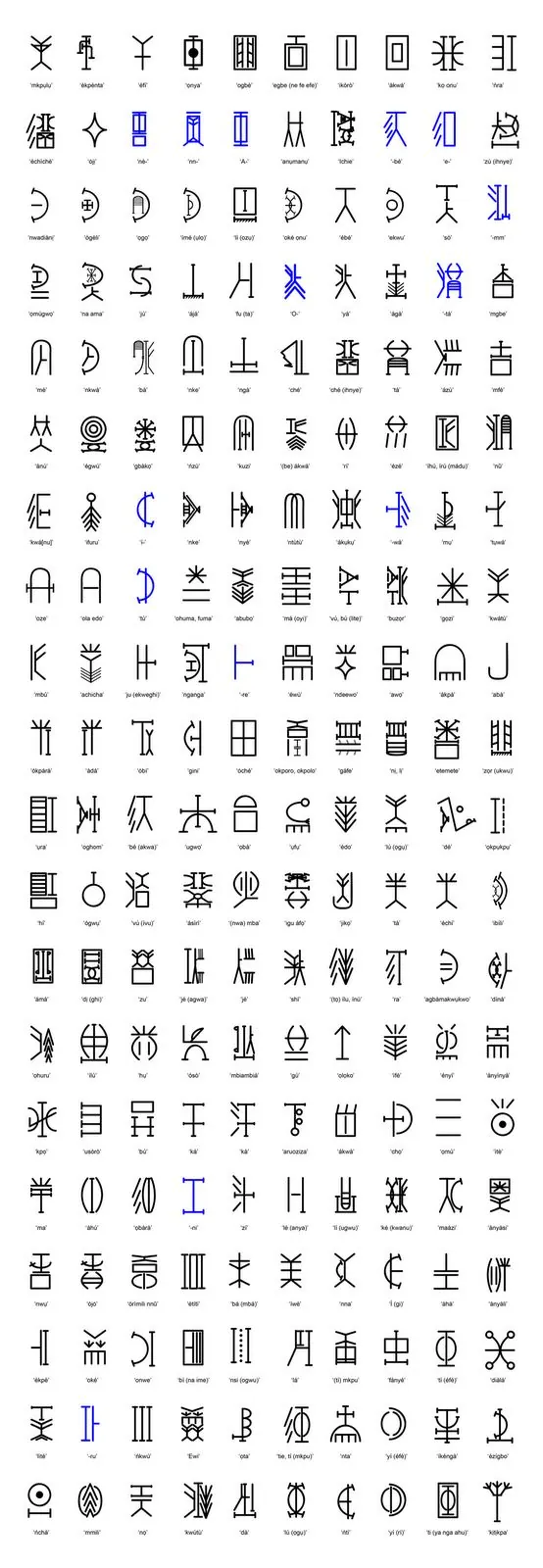
  • A tall chart of Nsibidi characters in black, a few highlighted in blue, each with a small English gloss under it.
    A long list of Nsibidi characters Source not found
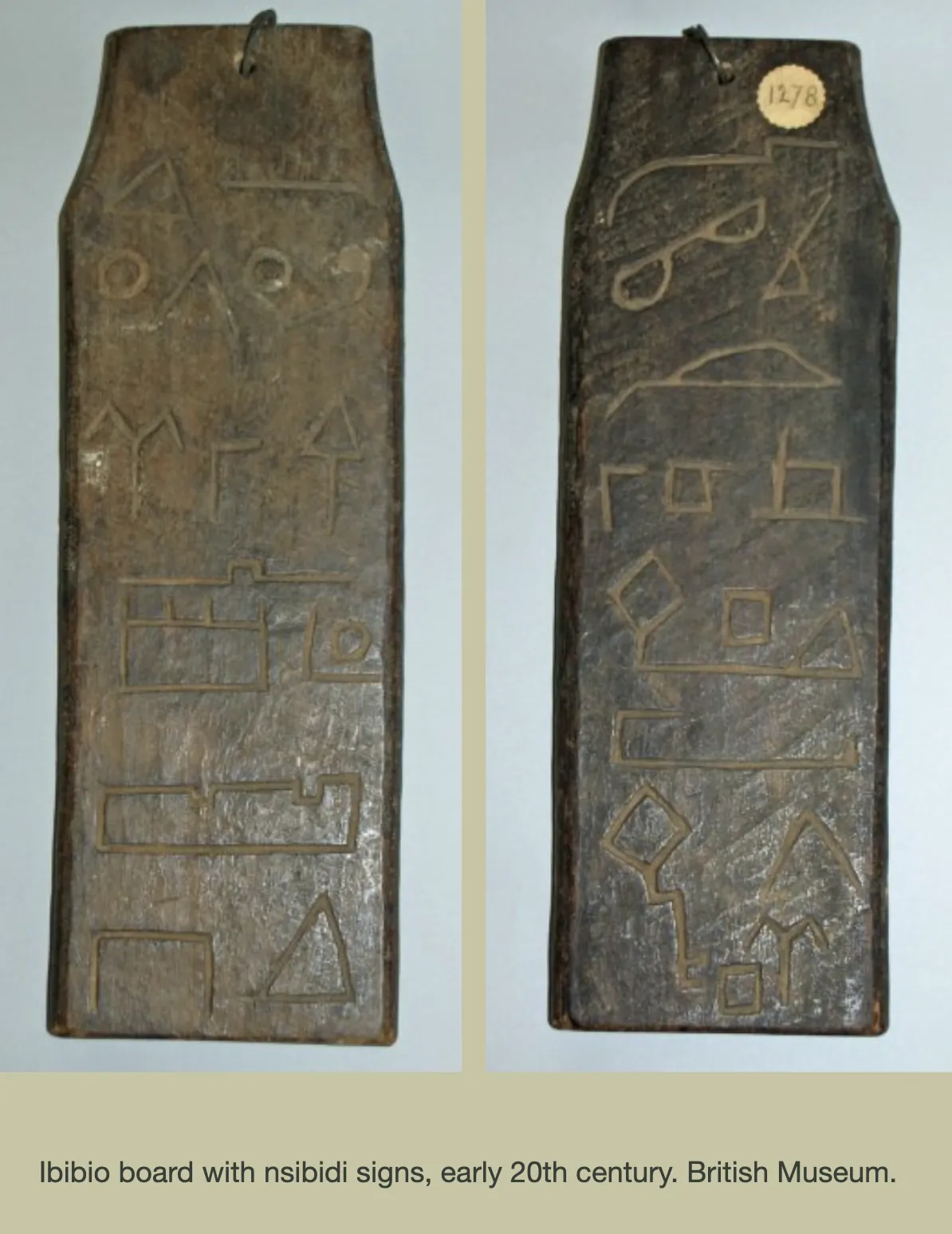
  • Both faces of a dark wooden board with a metal hanging loop, carved with Nsibidi signs: triangles, circles, house-like outlines and forked signs; a paper label reads 1278. The caption reads “Ibibio board with nsibidi signs, early 20th century. British Museum.”
    Ibibio board with Nsibidi signs The screenshot’s caption credits the British Museum
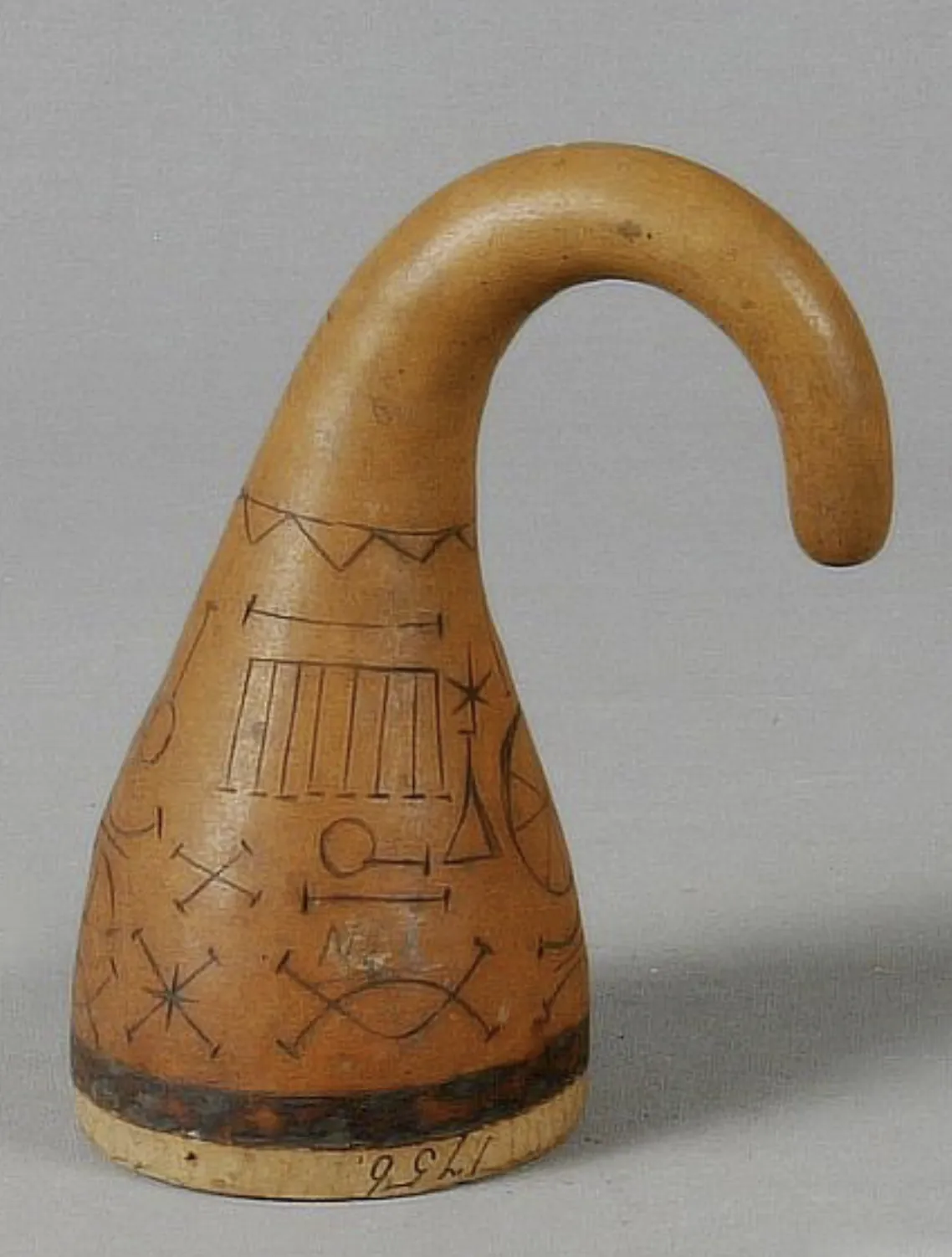
  • A hook-necked gourd on grey, incised with Nsibidi signs (crossed arcs, a comb shape, a star and a circle on a line), with a dark band at the base and a number inked on it.
    Gourd incised with Nsibidi signs Source not found
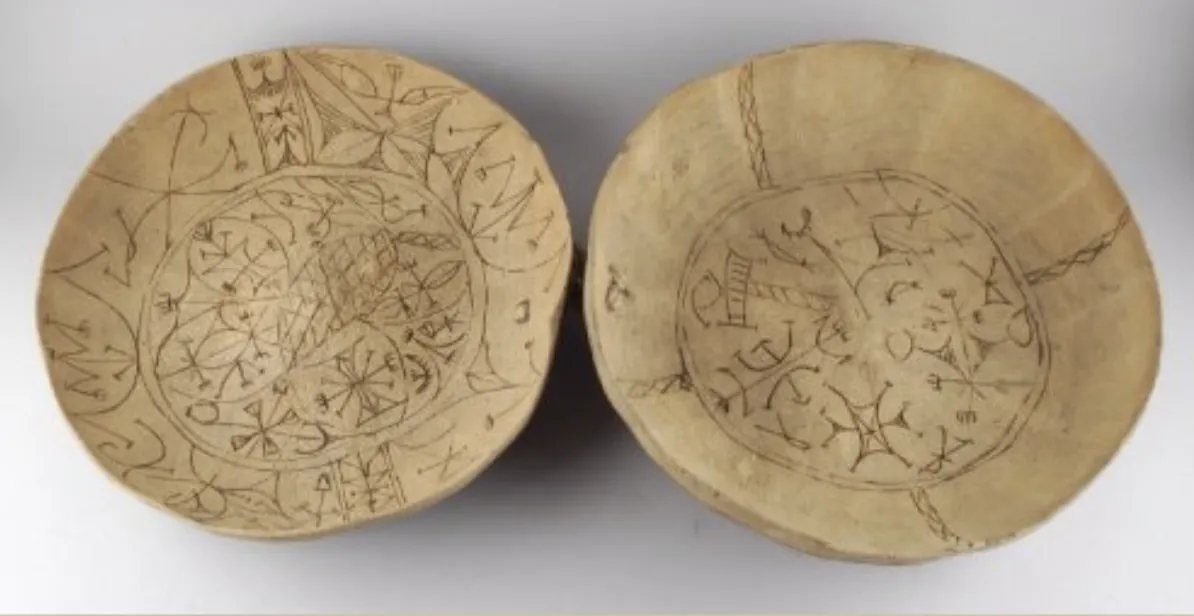
  • Two pale calabash bowls seen from above, their insides incised with dense Nsibidi signs arranged in circles and bands.
    Two calabash bowls incised with Nsibidi Source not found
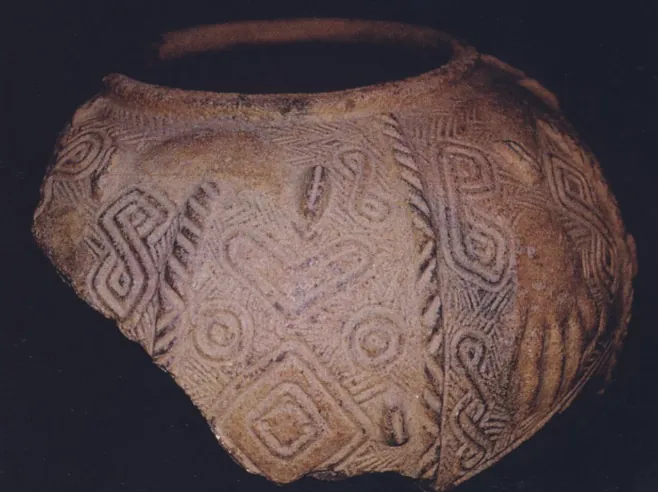
  • A large, broken clay pot on black, decorated with raised spirals, concentric circles, diamonds and rope-like bands.
    Decorated clay pot Source not found
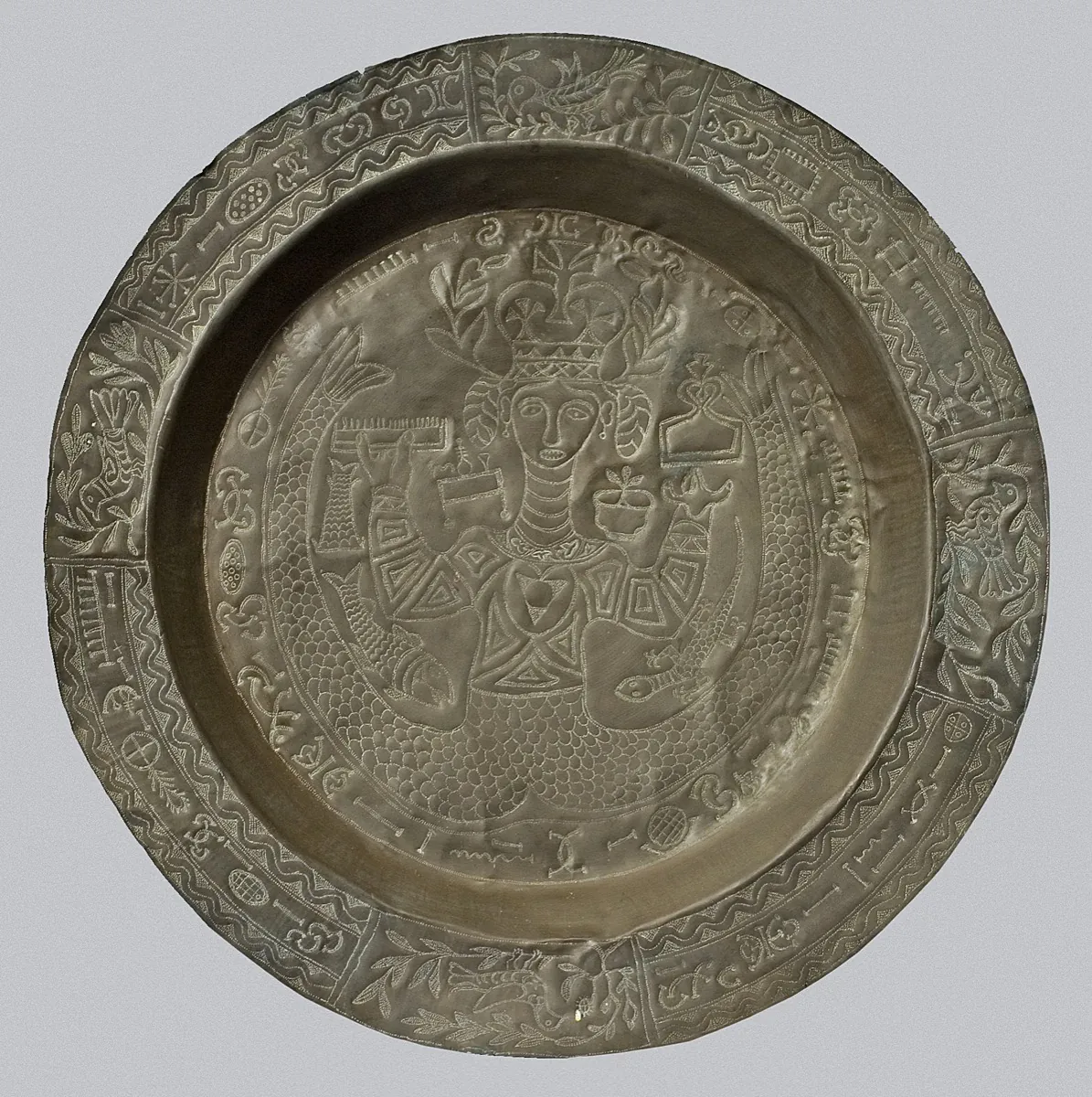
  • A round hammered brass dish: a crowned mermaid holding objects at the centre, surrounded by fish scales, birds and Nsibidi signs in panels around the rim.
    Brass mermaid dish, Old Calabar Brass mermaid dish, Nigeria, Pitt Rivers Museum Efik, Old Calabar; collected by 1919. Pitt Rivers Museum 1942.13.1089.
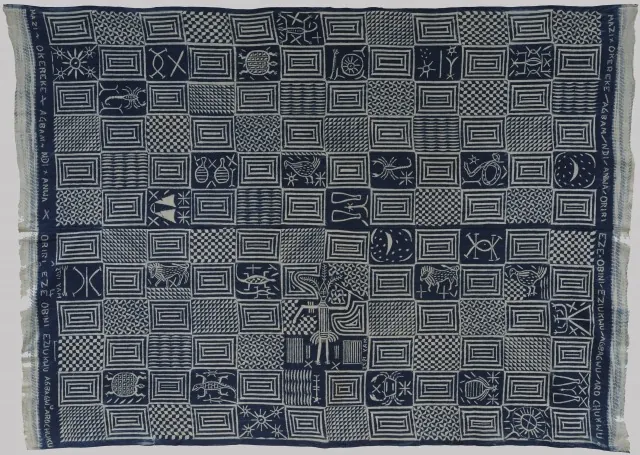
  • An indigo ukara cloth laid out flat: a grid of squares with concentric rectangles and checks, white Nsibidi figures, animals and signs, and names written along the borders.
    Ukara cloth Source not found
  • Two strips of red “Fragile, handle with care” tape crossing on black, printed with a broken-glass symbol and Chinese and Japanese text.
    Handle with care Handle with care, FlyD on Unsplash

Journal pages

Pages from the early records of Nsibidi, grouped by article. 28 images

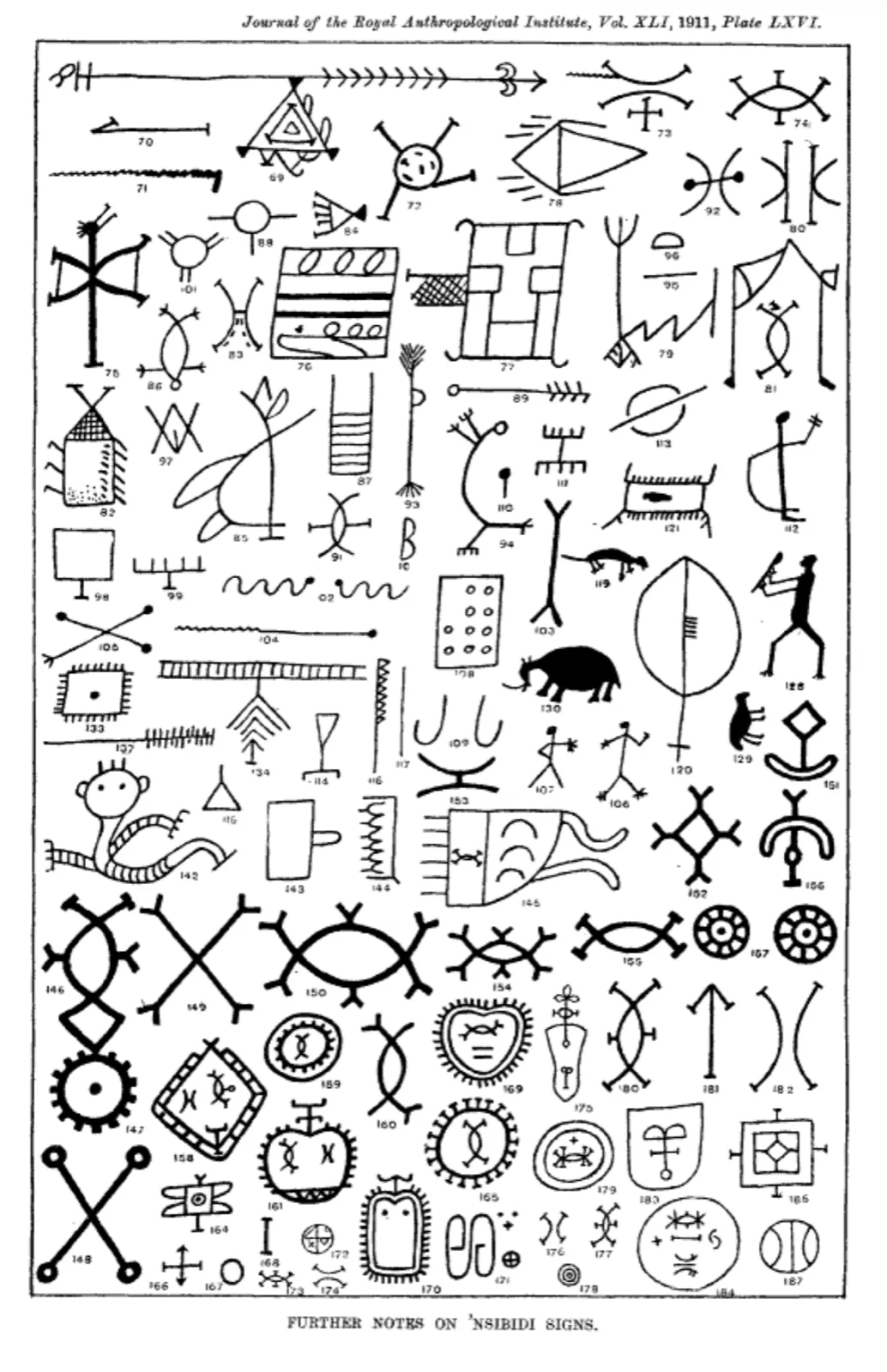
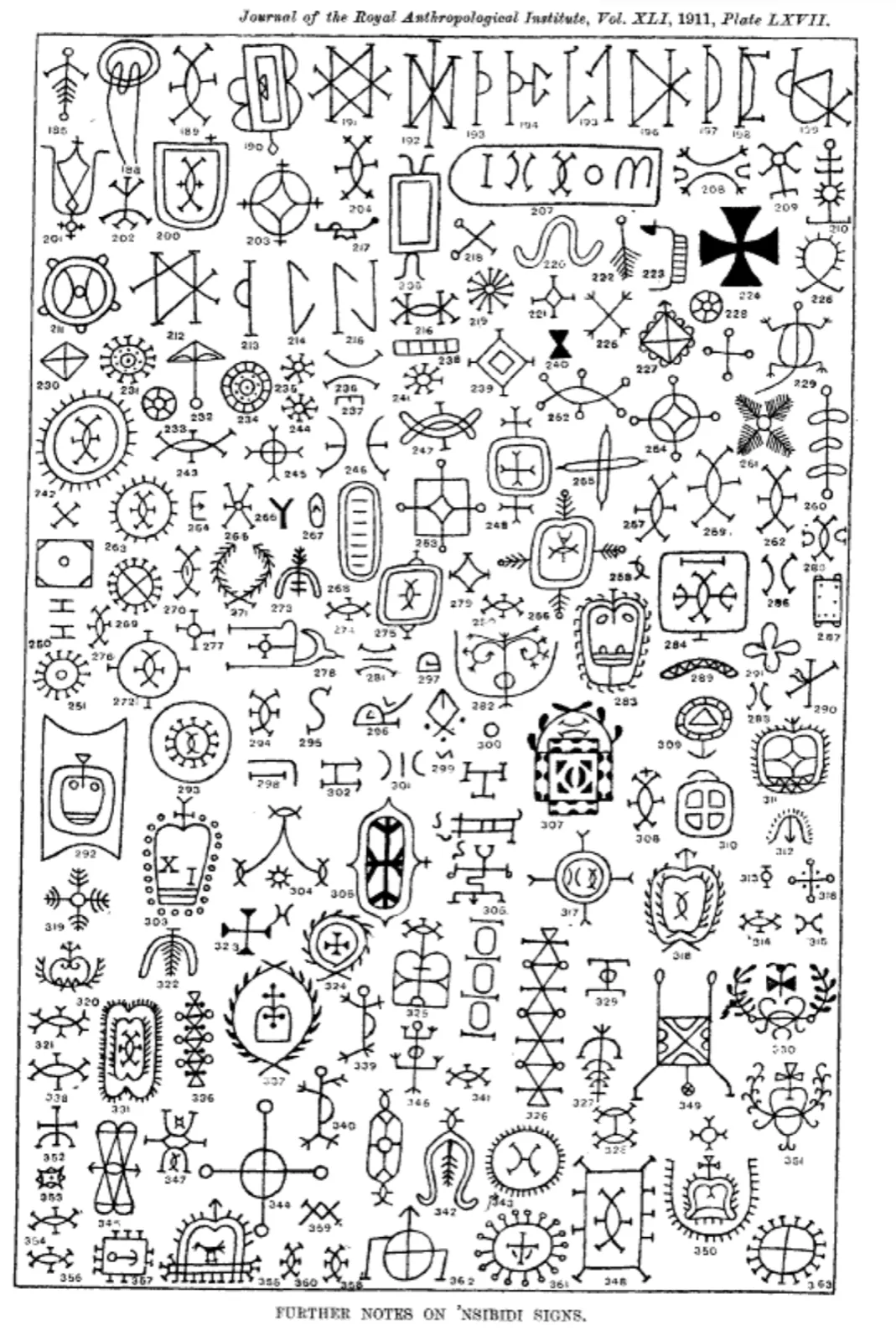
Further Notes on ’Nsibidi Signs with Their Meanings from the Ikom District, Southern Nigeria

Elphinstone Dayrell, Journal of the Royal Anthropological Institute 41 (1911), 521–540, plates LXV–LXVII · JSTOR 2843186

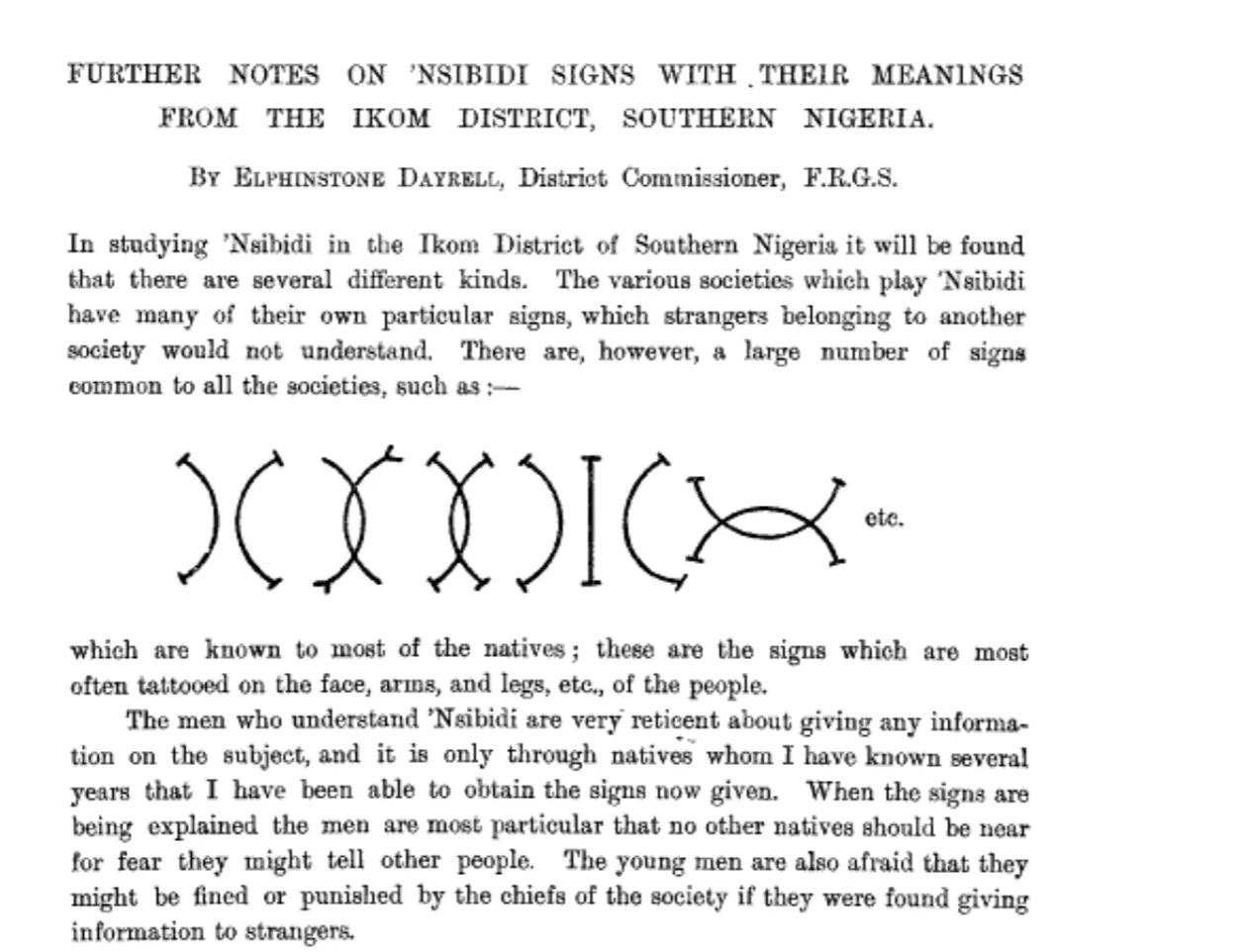
  • Dayrell (1911). The opening of the article: title, author, and the common signs that are “most often tattooed on the face, arms, and legs”.
    Page 521
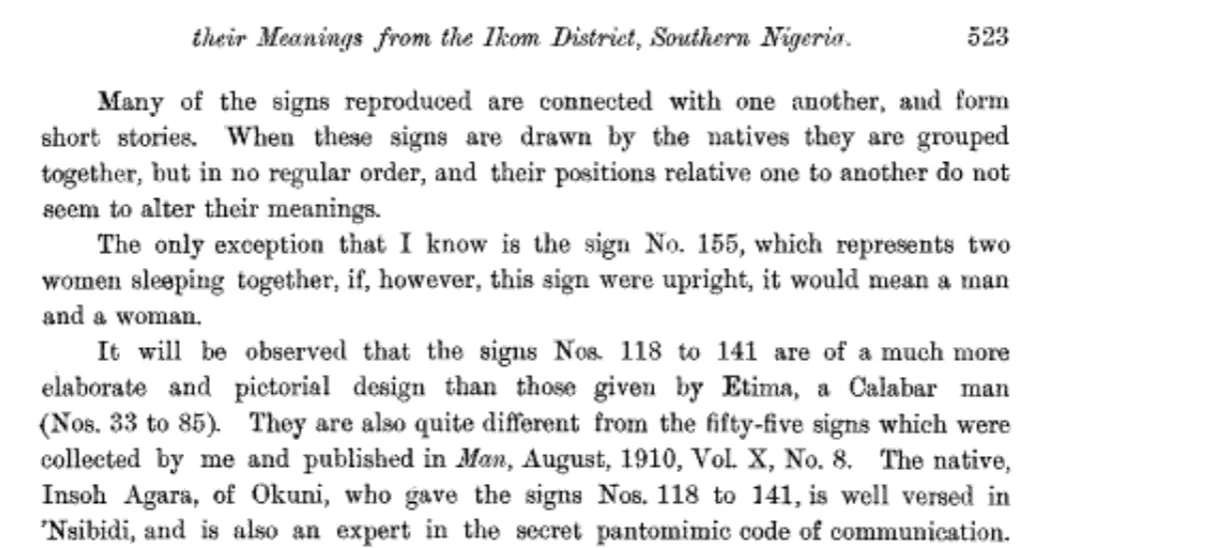
  • Dayrell (1911). Part of page 523: signs that form short stories, and who gave Dayrell which signs.
    Page 523 (part)
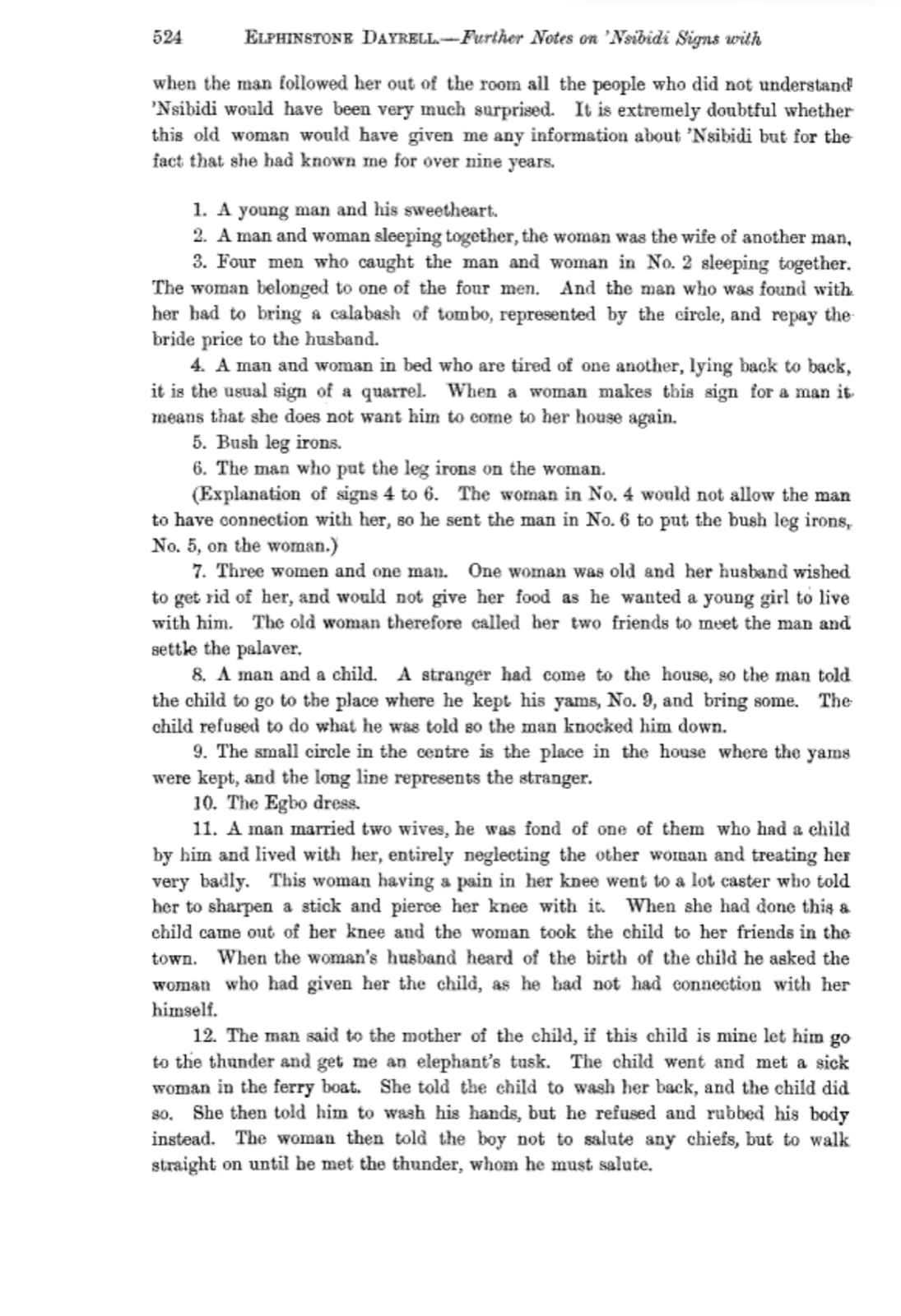
  • Dayrell (1911). Page 524: numbered meanings of signs 1 to 12.
    Page 524
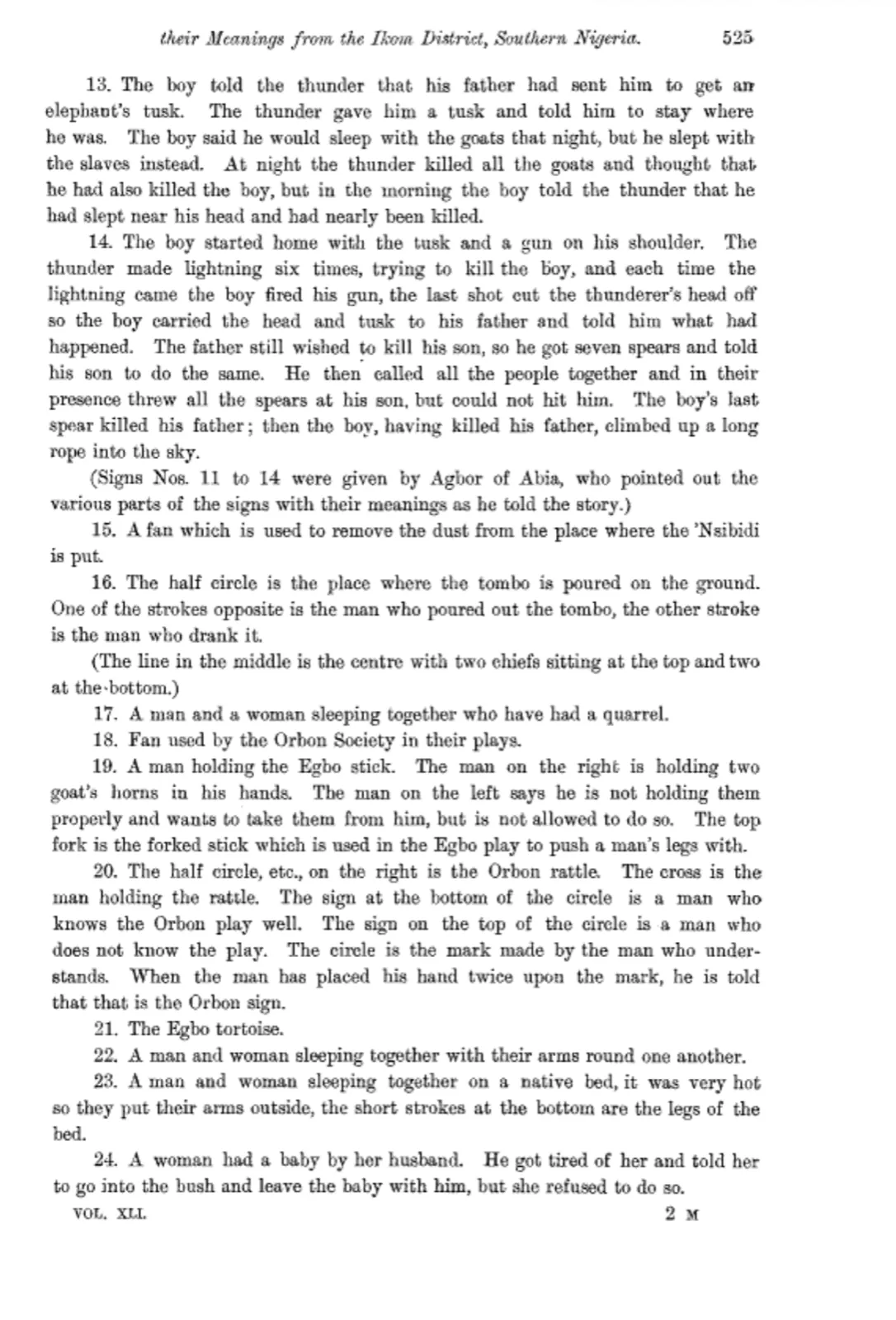
  • Dayrell (1911). Page 525: meanings of signs 13 to 24.
    Page 525
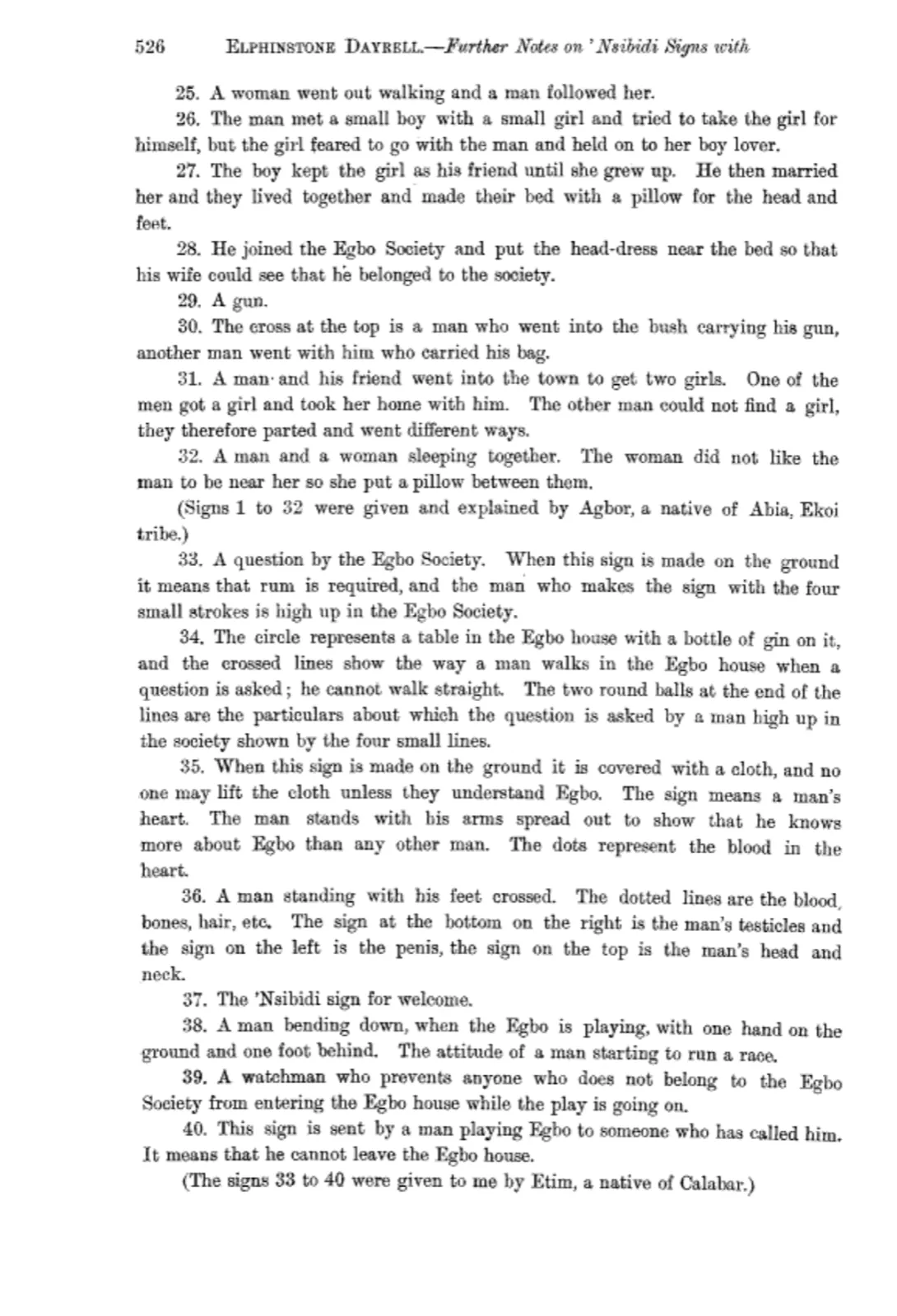
  • Dayrell (1911). Page 526: meanings of signs 25 to 40.
    Page 526
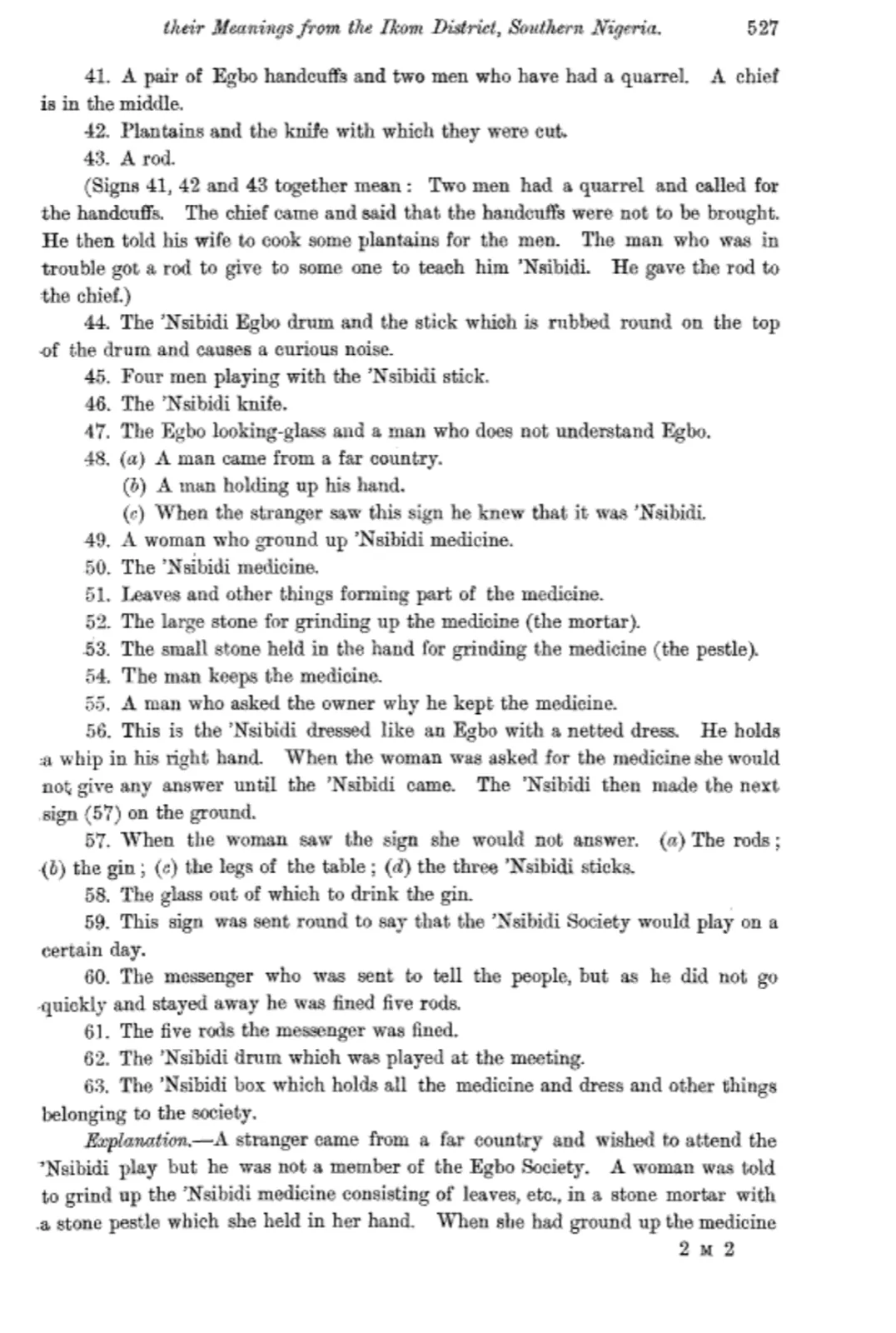
  • Dayrell (1911). Page 527: meanings of signs 41 to 63.
    Page 527
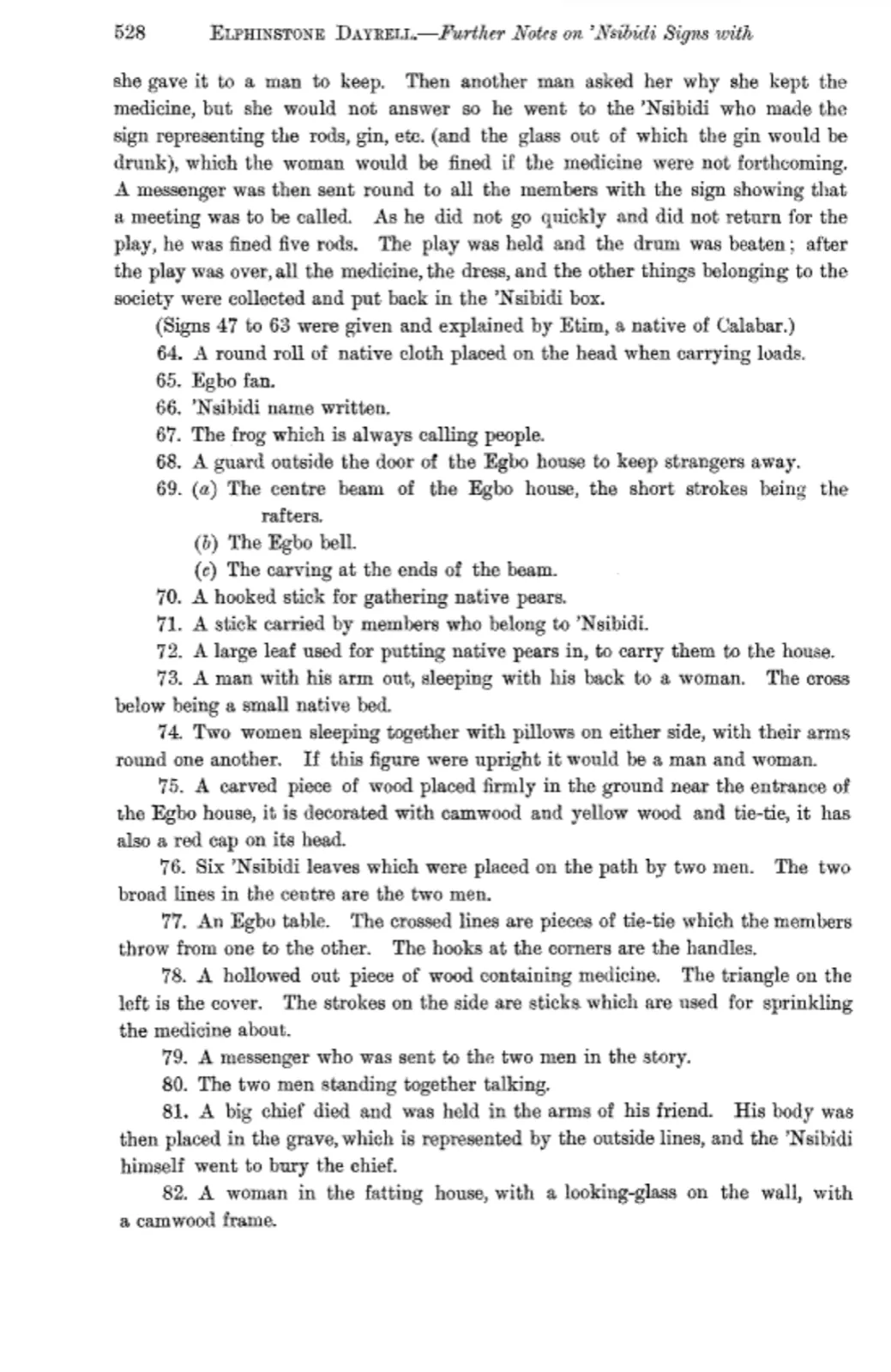
  • Dayrell (1911). Page 528: meanings of signs 64 to 82.
    Page 528
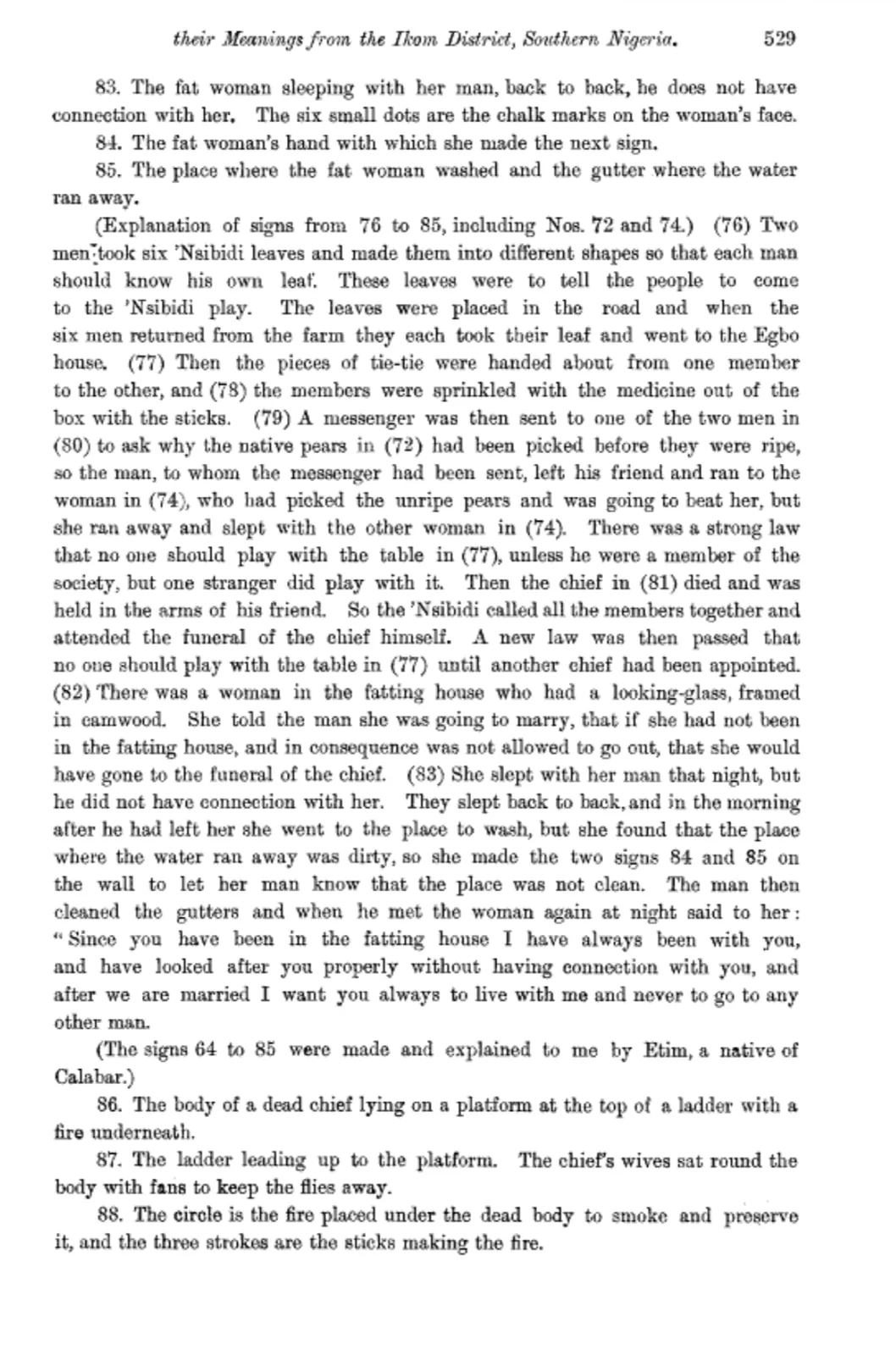
  • Dayrell (1911). Page 529: meanings of signs 83 to 88, with the story behind signs 76 to 85.
    Page 529
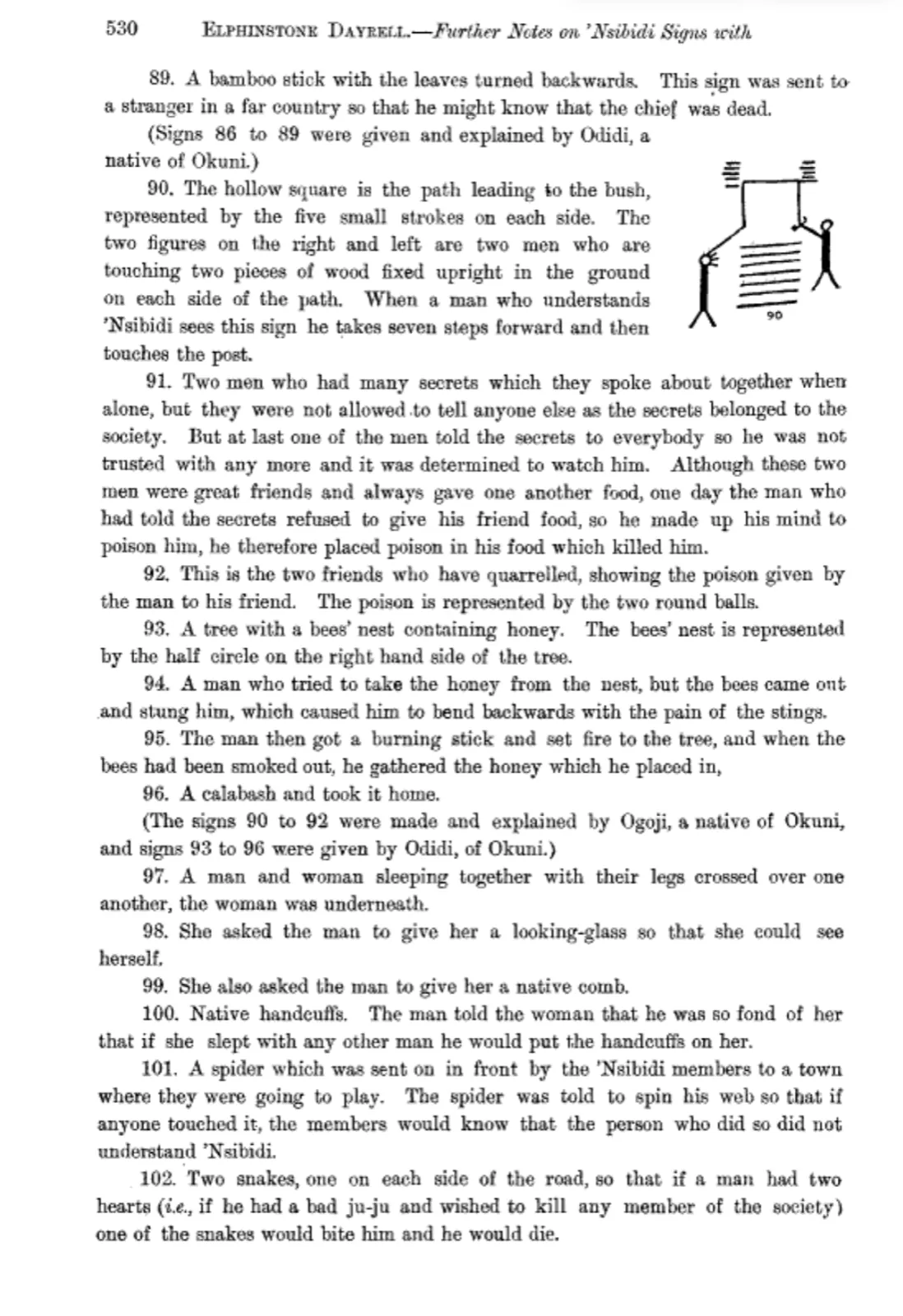
  • Dayrell (1911). Page 530: meanings of signs 89 to 102, with a drawing of sign 90.
    Page 530
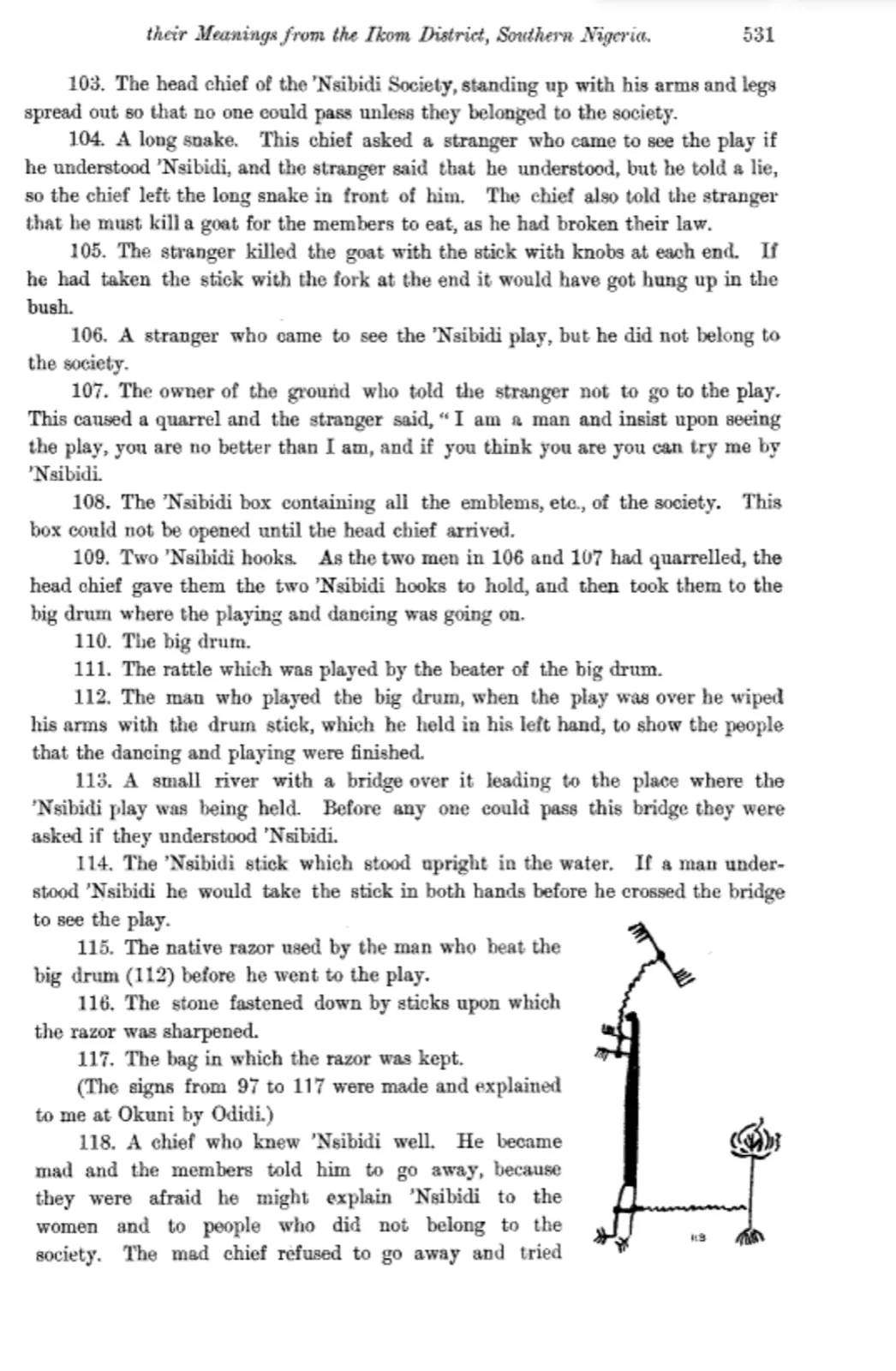
  • Dayrell (1911). Page 531: meanings of signs 103 to 118, with a drawing of a figure holding a stick.
    Page 531
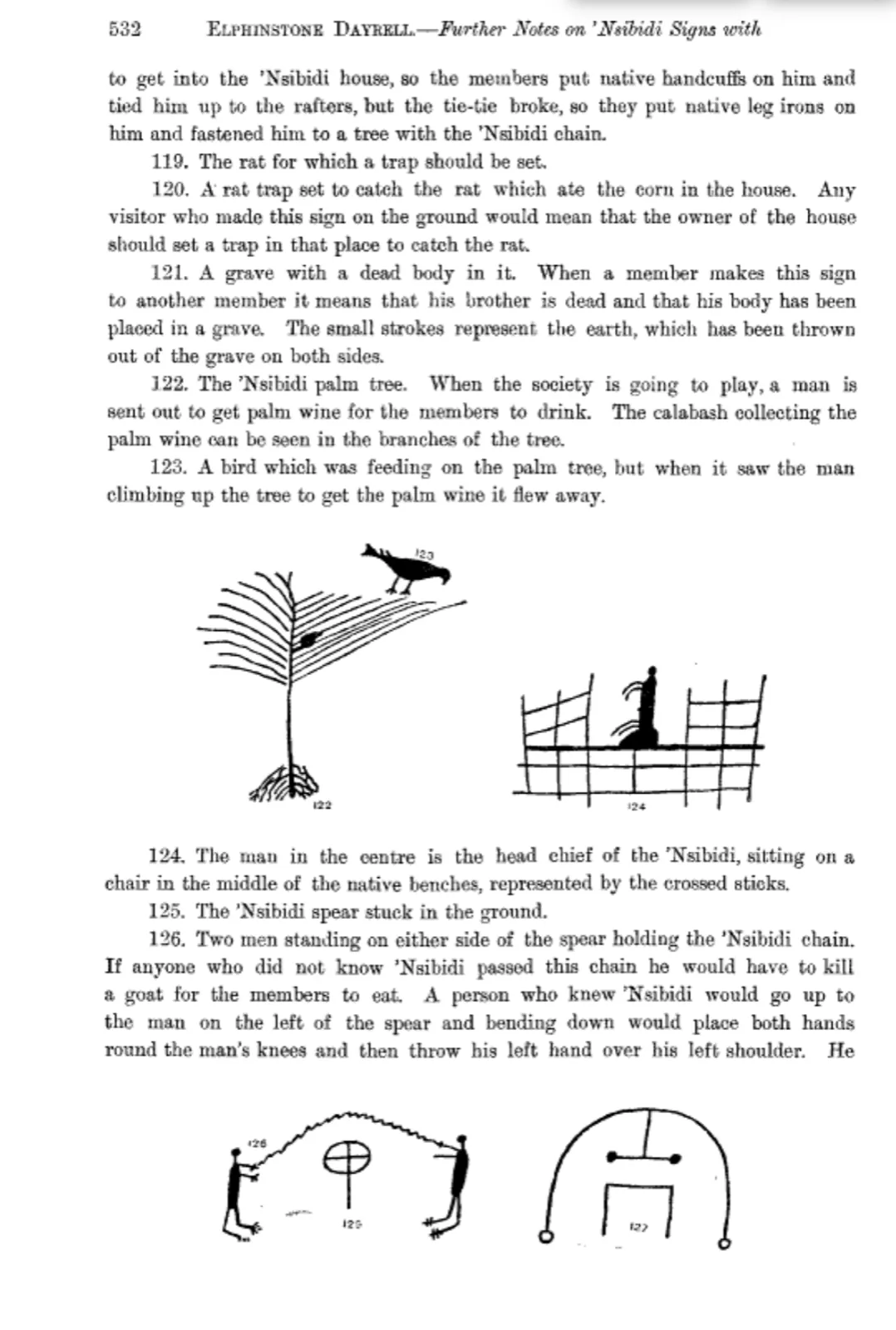
  • Dayrell (1911). Page 532: meanings of signs 119 to 126, with drawings of a bird on a palm tree and other signs.
    Page 532
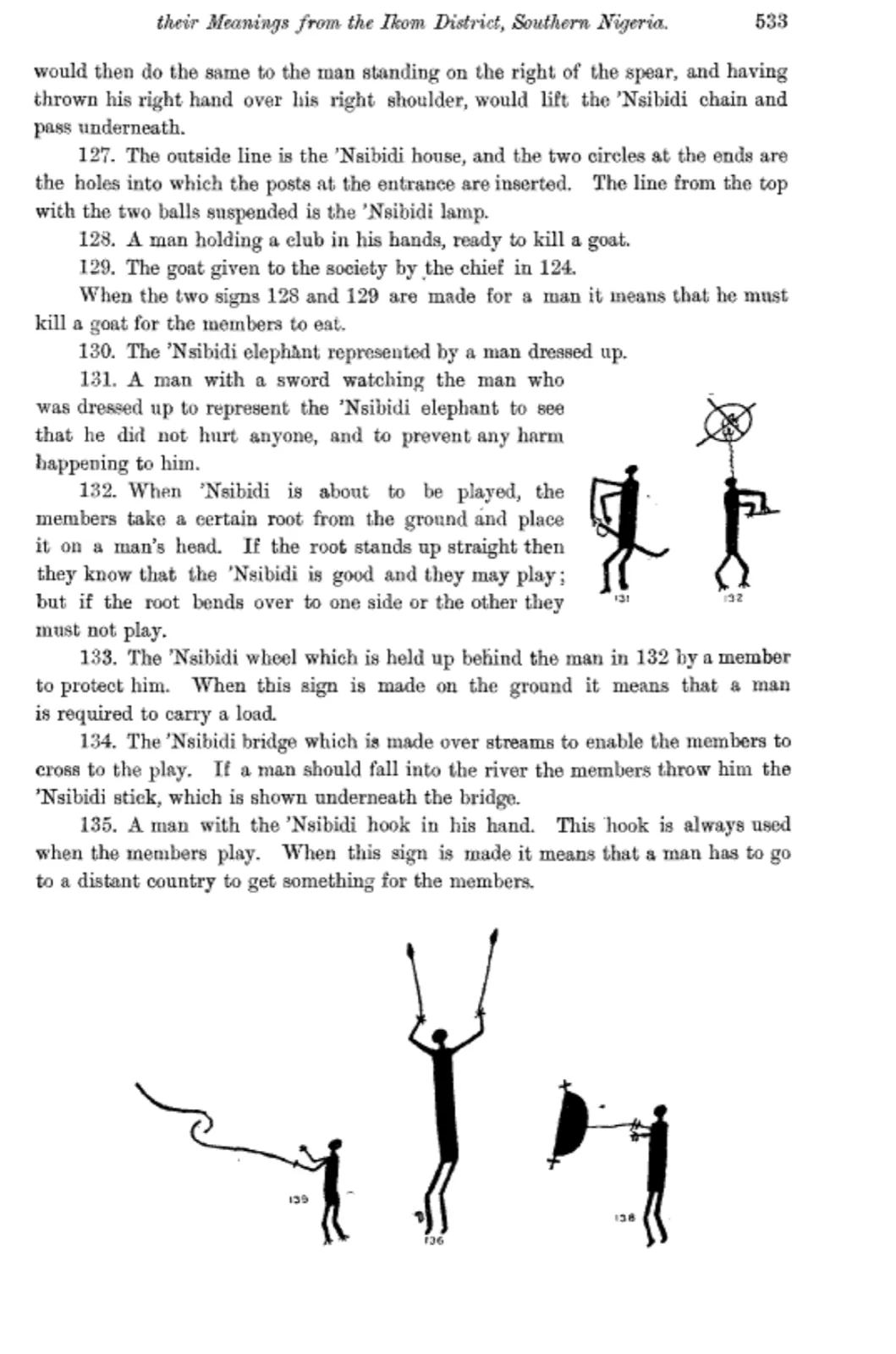
  • Dayrell (1911). Page 533: meanings of signs 127 to 135, with drawings of figures.
    Page 533
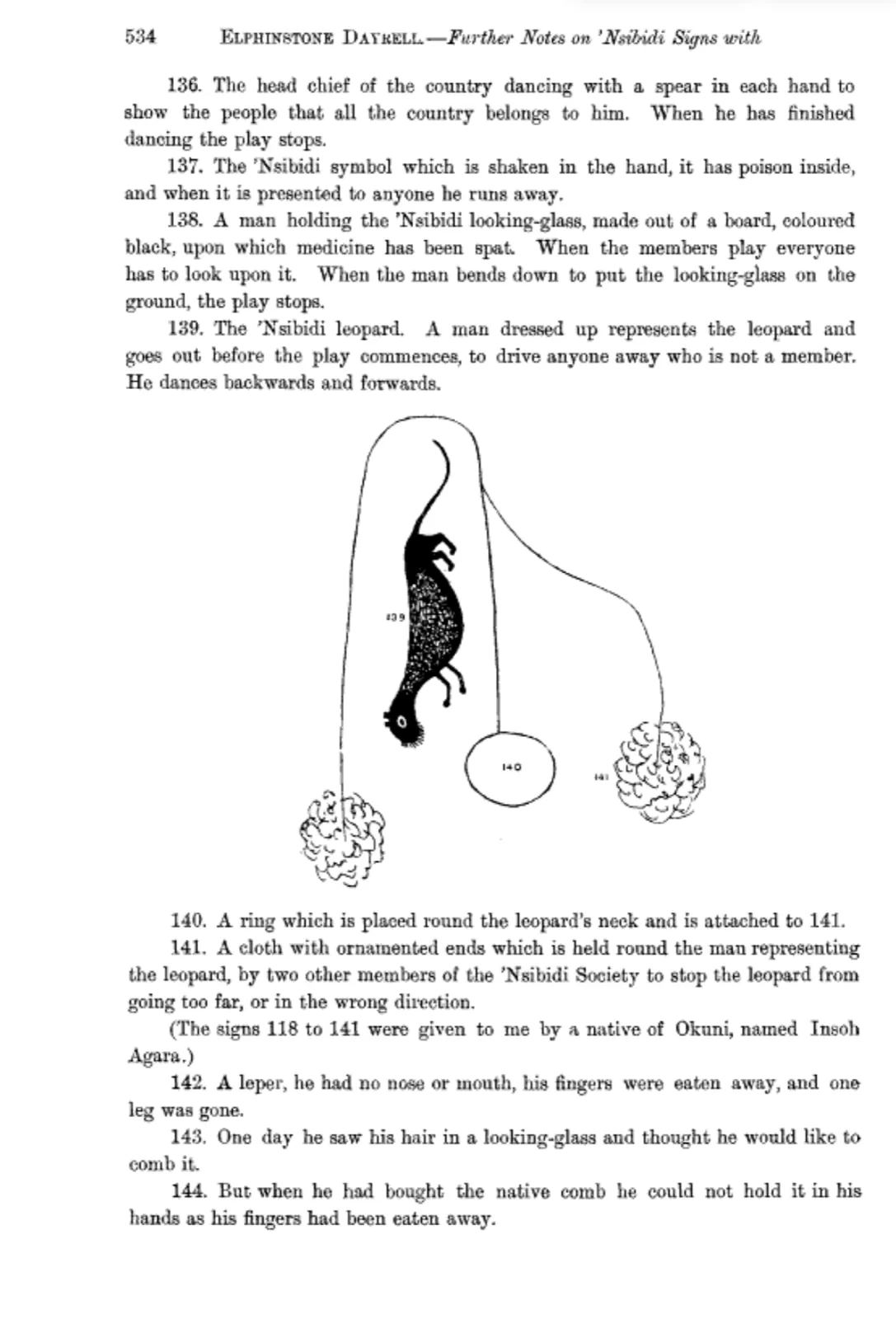
  • Dayrell (1911). Page 534: meanings of signs 136 to 144, with a drawing of the ’Nsibidi leopard (sign 139).
    Page 534
  • Dayrell (1911). Page 535: signs 145 to 157, tattooed signs and where on the body they were copied from.
    Page 535
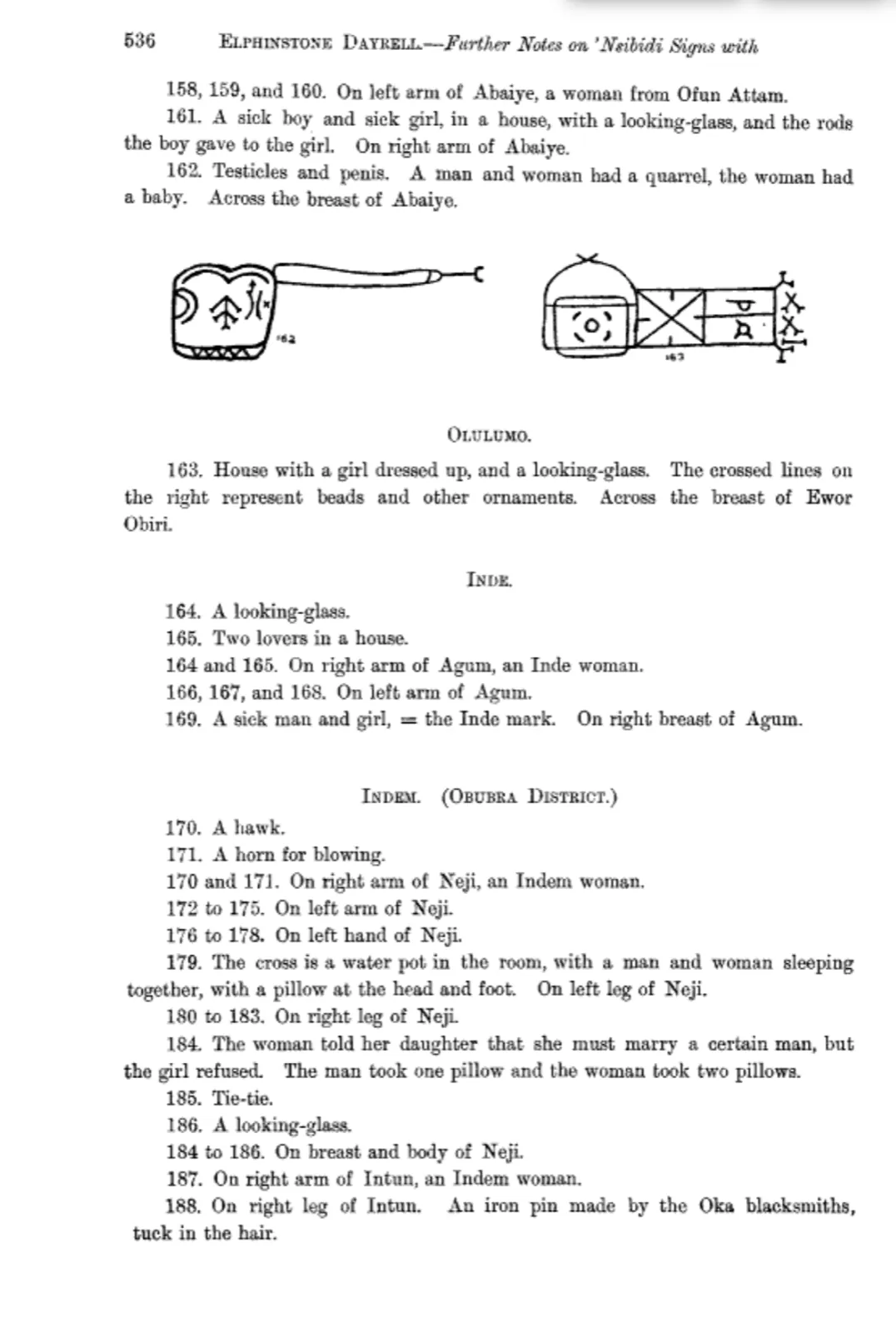
  • Dayrell (1911). Page 536: signs 158 to 188, with two drawings of houses.
    Page 536
  • Dayrell (1911). Page 537: signs 189 to 219, by district and tribe.
    Page 537
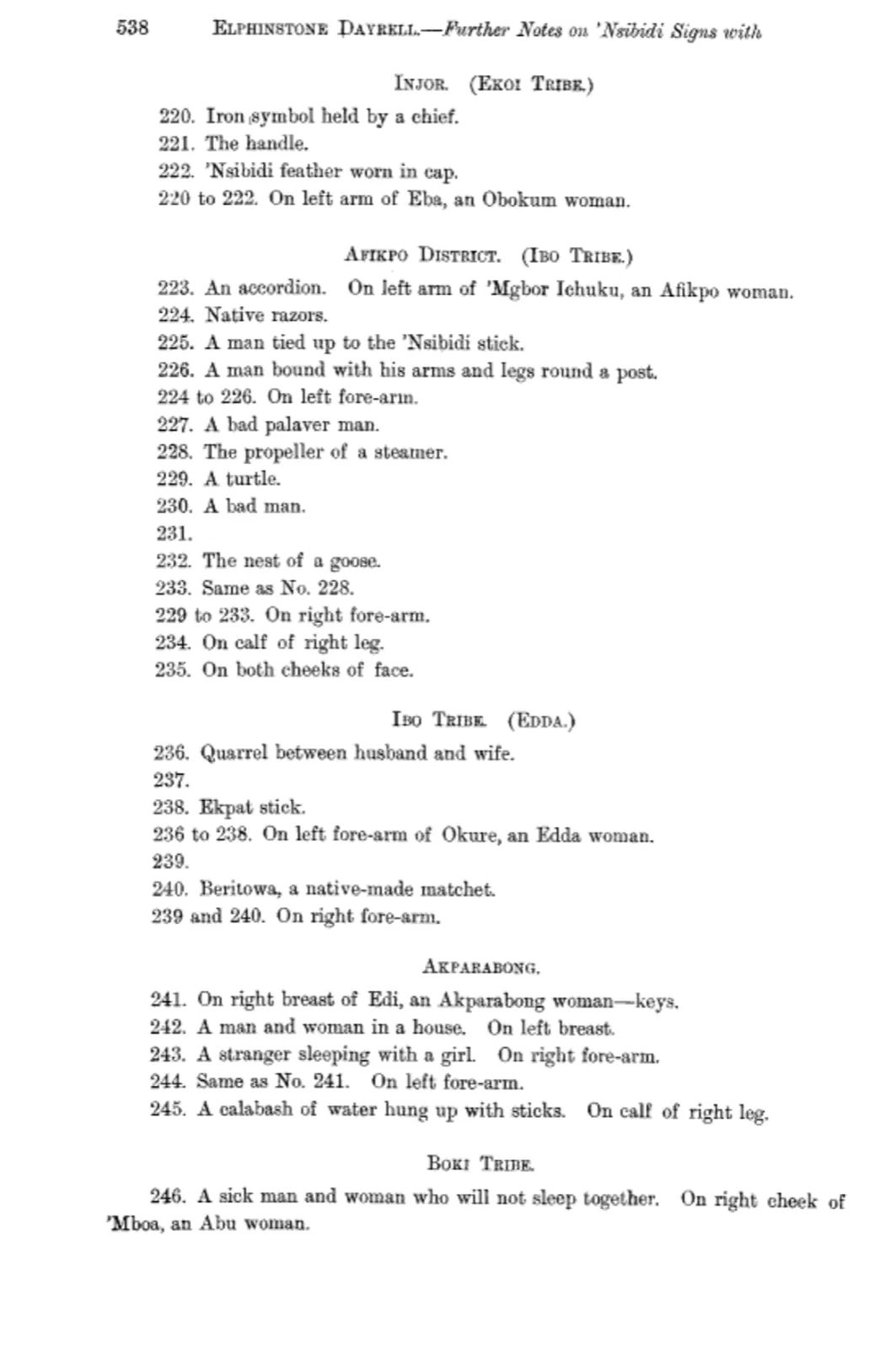
  • Dayrell (1911). Page 538: signs 220 to 246, by district and tribe.
    Page 538
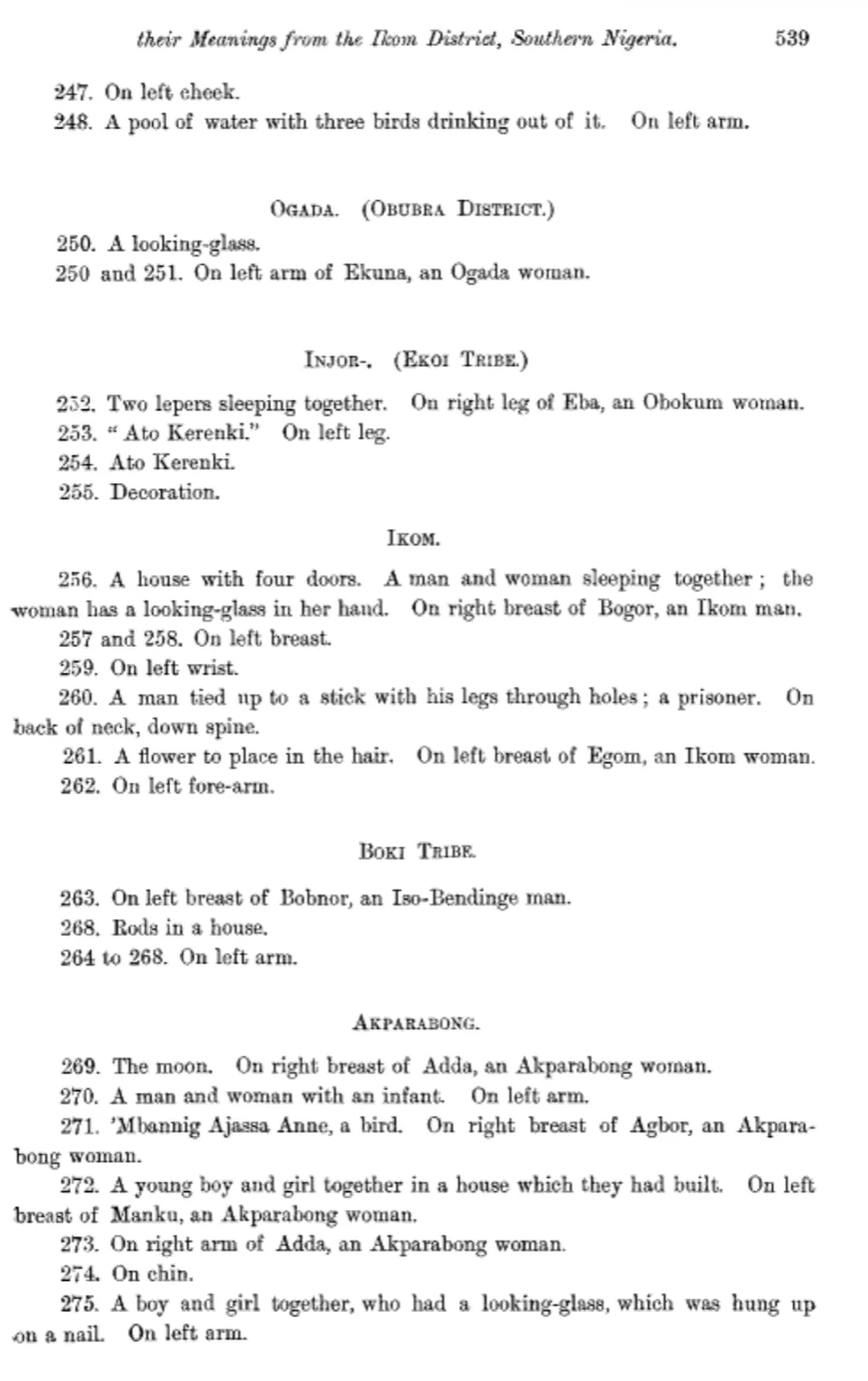
  • Dayrell (1911). Page 539: signs 247 to 275, by district and tribe.
    Page 539
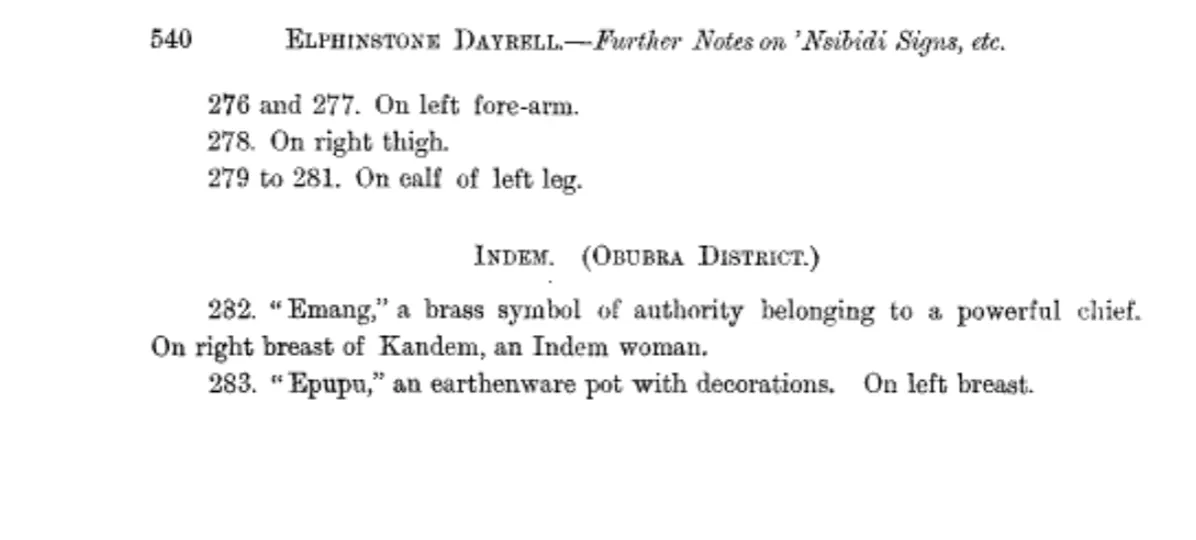
  • Dayrell (1911). Page 540, the last page: signs 276 to 283.
    Page 540
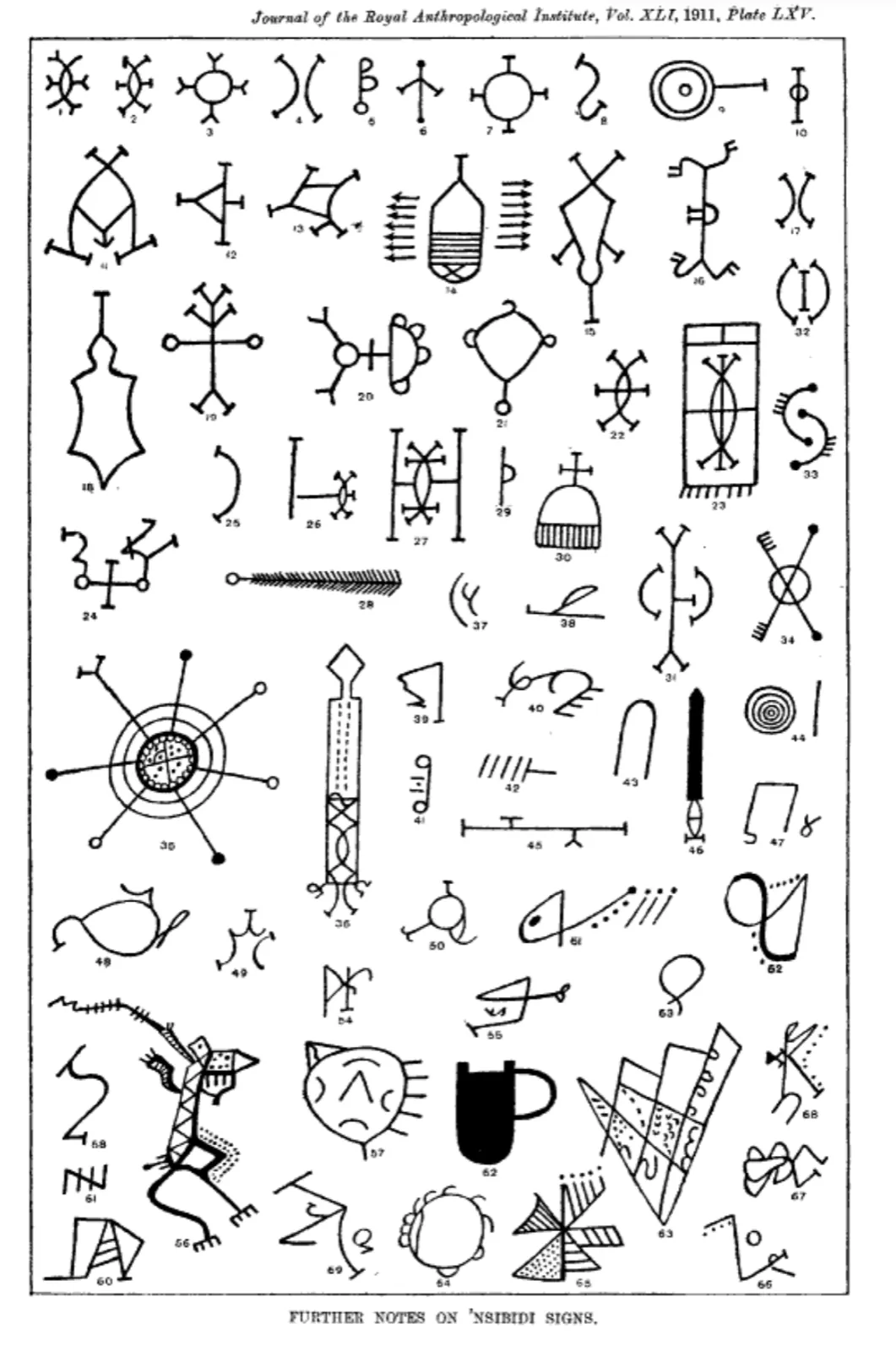
  • Dayrell (1911). Plate LXV: drawings of signs 1 to 69.
    Plate LXV
  • Dayrell (1911). Plate LXVI: drawings of signs 69 to 187, from figures and animals to circular emblems.
    Plate LXVI
  • Dayrell (1911). Plate LXVII: drawings of signs 185 to 363, densely packed.
    Plate LXVII

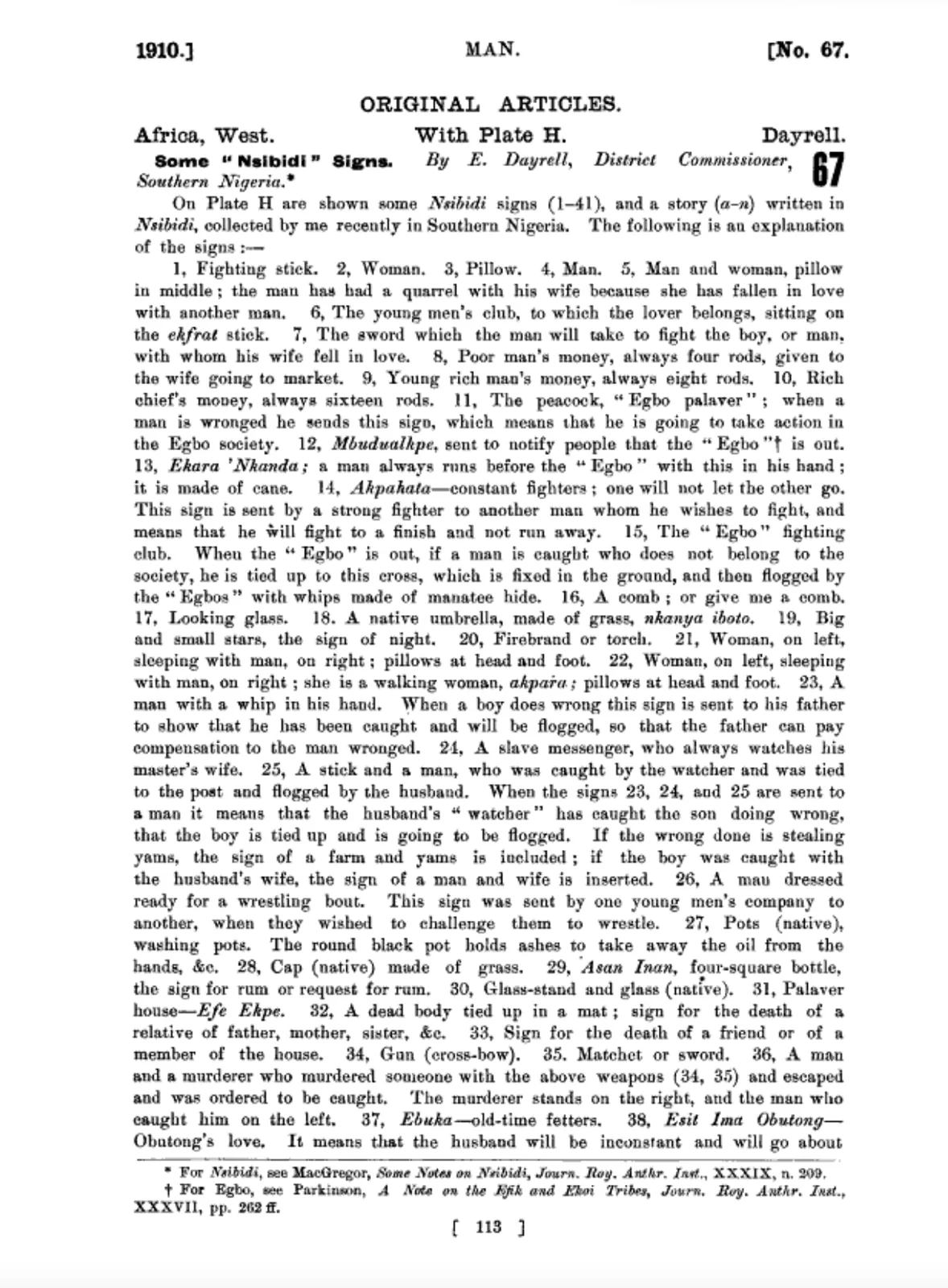
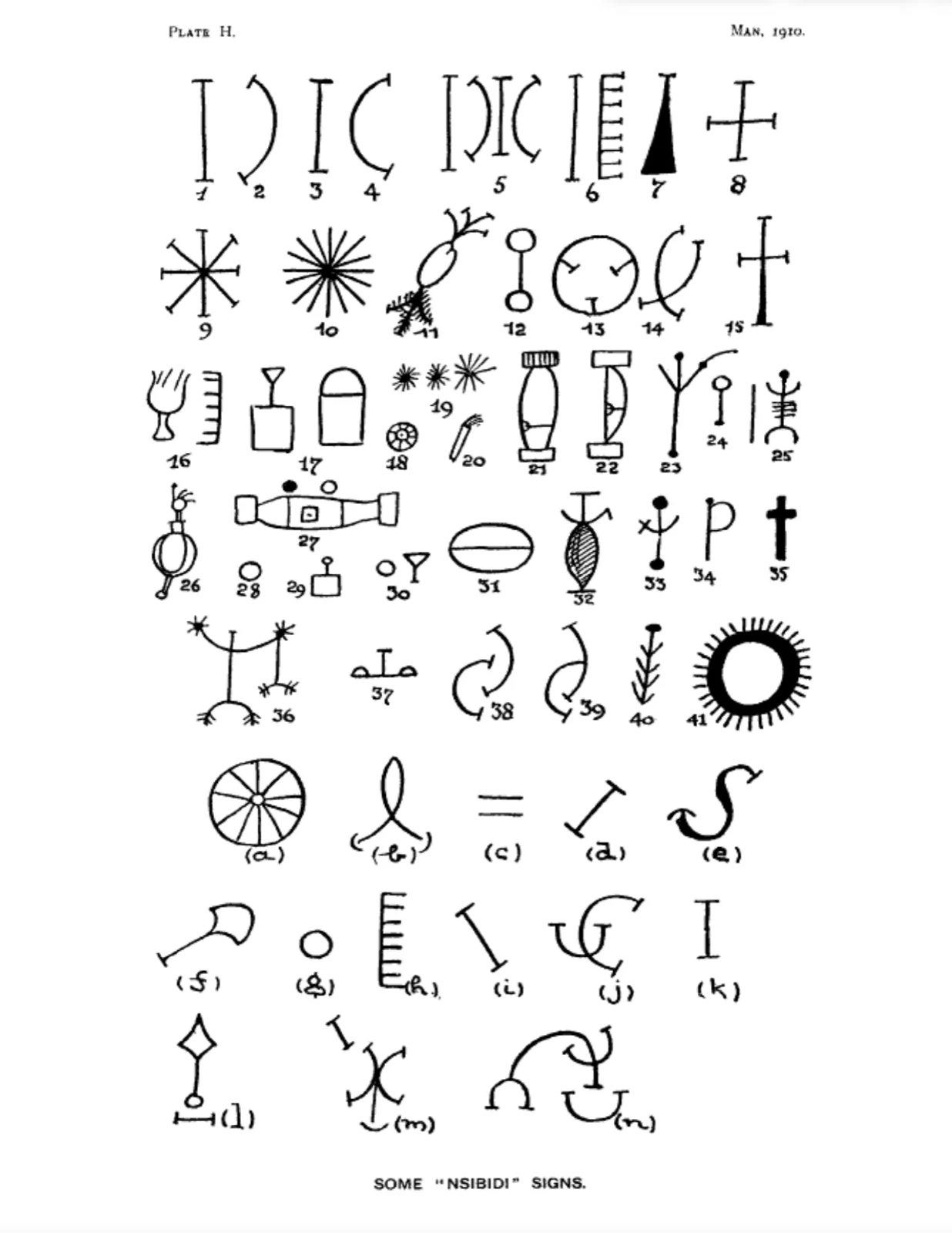
Some “Nsibidi” Signs

E. Dayrell, Man 10 (1910), no. 67, 113–114, plate H · doi:10.2307/2787339

  • Dayrell (1910). Page 113: the meanings of signs 1 to 38.
    Page 113
  • Dayrell (1910). Plate H, “Some ‘Nsibidi’ signs”: drawings of signs 1 to 41 and a to n.
    Plate H
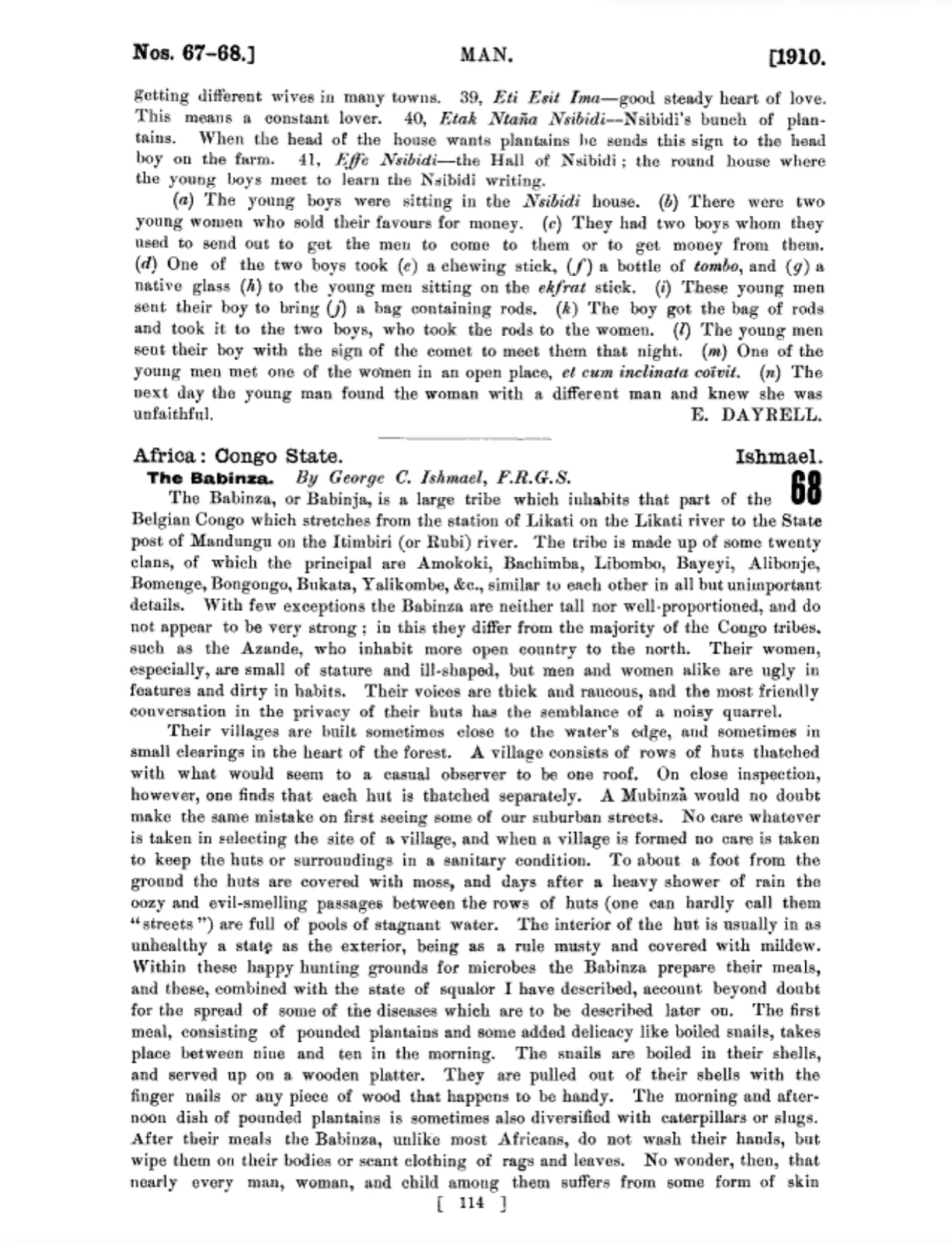
  • Dayrell (1910). Page 114: signs 39 to 41 and a to n, then the start of another article, on the Babinza.
    Page 114

An article on Nsibidi in Ibibio art

Article not identified yet; its figures cite Nsentip (2008)

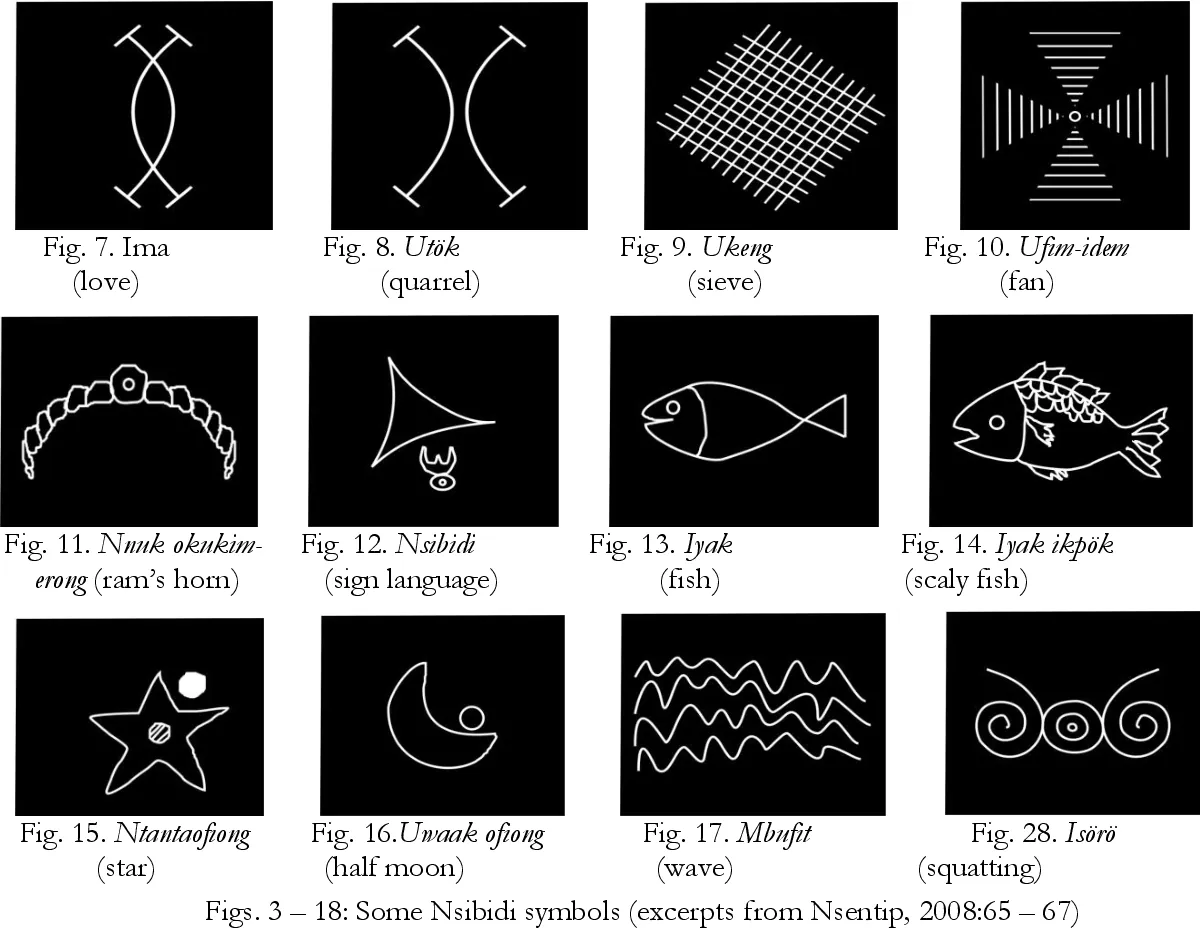
  • Twelve Nsibidi symbols drawn in white on black panels with their Ibibio names: love, quarrel, sieve, fan, ram’s horn, sign language, fish, scaly fish, star, half moon, wave and squatting.
    Some Nsibidi symbols, after Nsentip (2008)
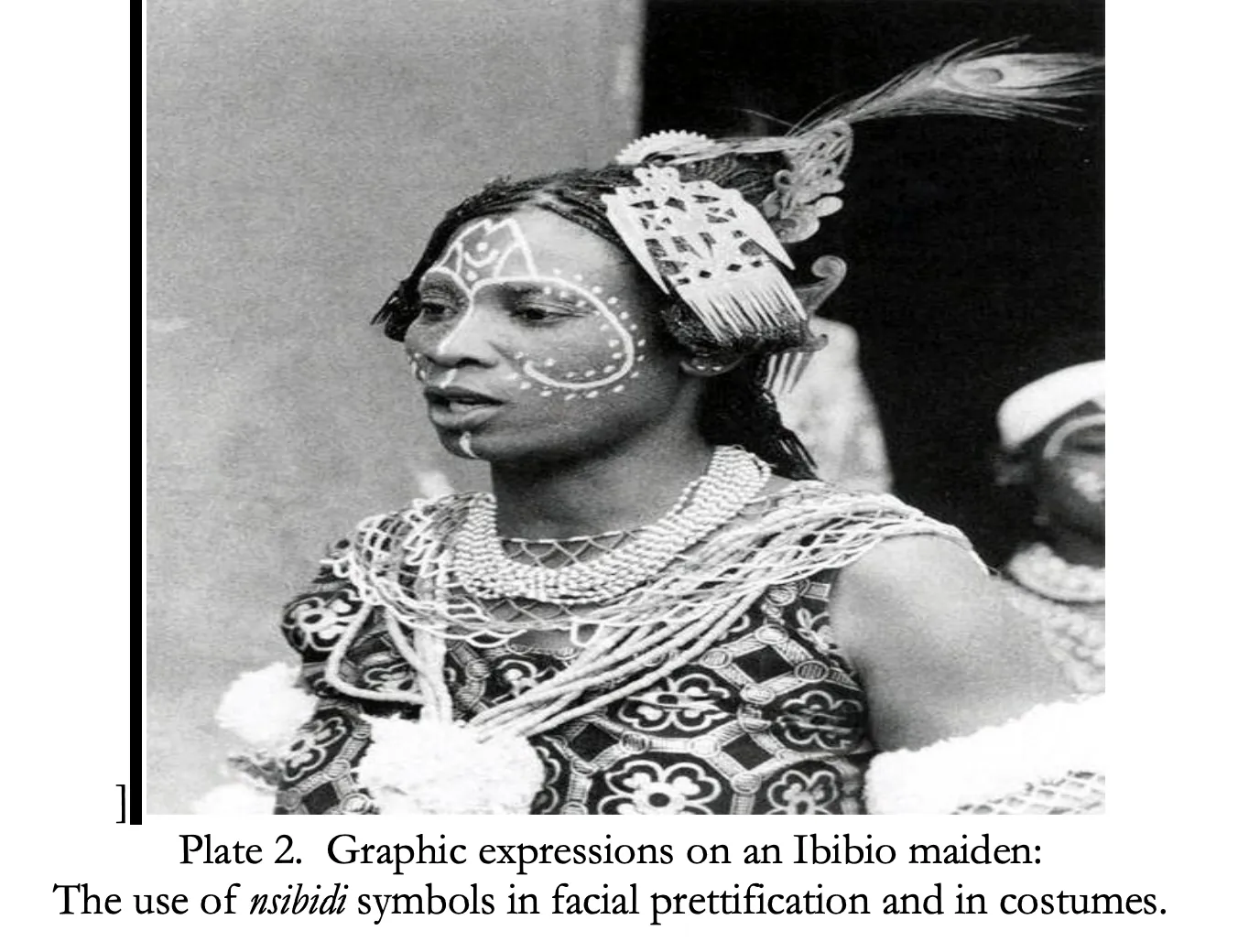
  • A black-and-white photograph of a young woman with white dotted designs painted on her face, a carved comb in her hair and many strands of beads, captioned “Graphic expressions on an Ibibio maiden: the use of nsibidi symbols in facial prettification and in costumes.”
    Plate 2: Nsibidi on an Ibibio maiden
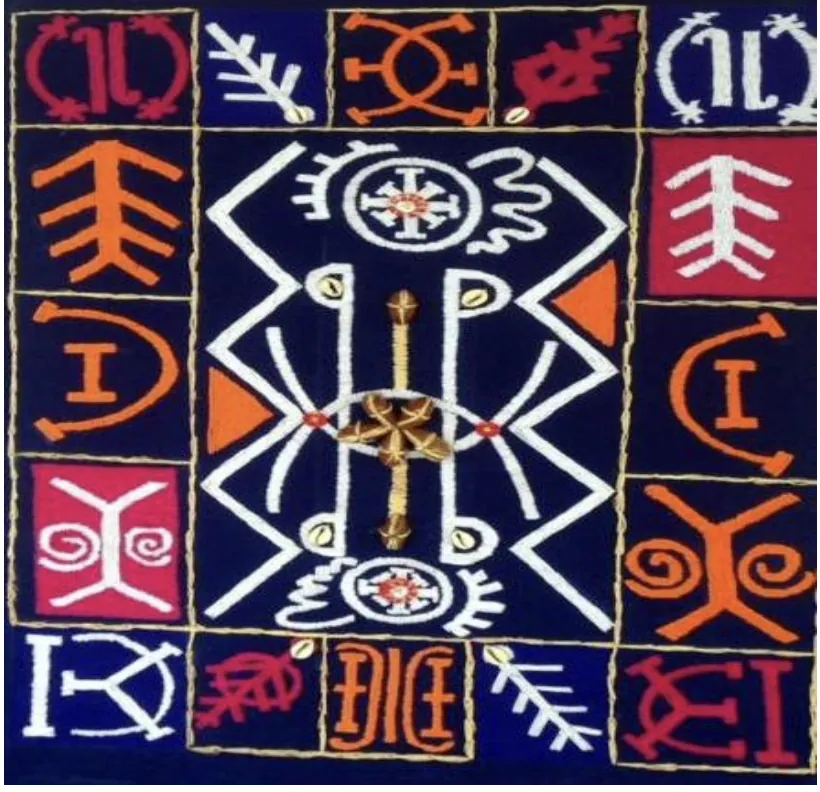
  • An embroidered textile panel on dark blue: Nsibidi signs in white, orange and red in a grid of squares around a central figure, with cowrie shells sewn on.
    Embroidered panel of Nsibidi signs